Introduction
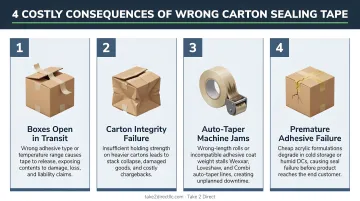
The wrong carton sealing tape is a surprisingly expensive problem. Seals that pop in transit generate product damage claims. Re-taping labor eats into fulfillment margins. Mismatched tape on automated case sealers causes jams that pull a maintenance technician away from other work — Shurtape estimates that technicians may address sealer issues 5–10 times per day when tape and machine compatibility aren't aligned.
None of those costs are obvious until they're already hitting your operation. With dozens of options varying by adhesive type, mil thickness, temperature rating, and application method, choosing the right tape is less straightforward than it looks. This guide covers the four main tape types by use case, how to match tape to your specific operation, and the selection mistakes that cost distribution facilities and 3PLs the most.
Key Takeaways
- Acrylic tape is best for general ambient shipping and long-term storage
- Hot melt performs better on recycled corrugated and high-speed automated lines
- Mil thickness should reflect carton weight and handling stress — not just roll price
- Cold-temperature tape is a separate product category; standard tape loses adhesion in refrigerated environments
- Water-activated tape (WAT) is the most tamper-evident and recyclable option, ideal for high-value goods
- Broad distributor inventory with same-day fulfillment prevents sourcing delays that lead to the wrong tape
What Is Carton Sealing Tape and Why Does It Matter for Industrial Operations?
Carton sealing tape is a pressure-sensitive or water-activated adhesive tape engineered specifically for sealing corrugated shipping cartons. It's a different product category from what you'll find in office supply stores: consumer packing tape is designed for light, short-term use, while industrial carton sealing tape is built for mechanical stress, temperature variation, and the handling volume of actual distribution environments.
The operational consequences of using the wrong tape are concrete:
- Popped seals during transit create product damage claims and customer service issues
- Re-taping adds direct labor cost at the packing station
- Tape-machine mismatches on automated case sealers cause jams, mis-cuts, and uneven seals — Shurtape notes that tape waste from rework alone can run 10–20% in many facilities
- Wrong adhesive for the substrate means a seal that looks complete but fails under load
Two variables define how any carton sealing tape performs: the backing material (typically biaxially oriented polypropylene film, or BOPP, for pressure-sensitive tapes; kraft paper for water-activated) and the adhesive system (acrylic, hot melt, or water-activated). Understanding both helps you match tape specs to your actual operating conditions.
Best Carton Sealing Tapes by Use Case
The tapes below are categorized by the operational scenario they best serve. Adhesive type, temperature rating, corrugated compatibility, and throughput requirements were all considered.
Best for General Industrial Shipping — Acrylic Carton Sealing Tape
Acrylic tape is the most widely used carton sealing tape in standard warehouse and distribution environments. It's built on a water-based emulsion adhesive that cures over time, producing a long-lasting bond with good UV and weathering resistance.
The clear, low-profile appearance and quiet unwind make it easy to work with at manual packing stations and on automated case sealers.
Key performance characteristics:
- Resists aging, yellowing, and UV degradation — well-suited for long storage windows
- Works reliably across a wide operating range (IPG's 191 acrylic tape is rated for temperatures above 40°F; Shurtape's AP Series lists a service range of -20°F to 180°F with application down to 20°F)
- Compatible with both hand dispensers and automated case sealers
- Performs well on virgin corrugated; less aggressive tack than hot melt
| Specification | Detail |
|---|---|
| Adhesive Type | Water-based acrylic |
| Typical Operating Range | ~40°F to 120°F (verify by product TDS) |
| Best For | General shipping, long-term storage, variable warehouse temperatures |
Best for High-Volume and Recycled Corrugated — Hot Melt Tape
Hot melt tape uses a synthetic rubber adhesive engineered for aggressive initial tack. It bonds fast, which matters on high-speed automated lines, and holds on the rough, porous surfaces common in high-recycled-content corrugated. According to the Fibre Box Association, the average corrugated box contains 52% recycled content — making surface adhesion a consistent real-world challenge.
Key performance characteristics:
- Superior adhesion on rough or dusty corrugated surfaces
- Strong shear resistance under load — IPG's 7100 hot melt lists holding power to linerboard at 7,000–7,500 minutes
- Fast bond formation supports high-speed case sealer throughput
- Limitations: UV and aging resistance is weaker than acrylic; underperforms below 45°F (IPG 7100 application range: 45°F to 120°F)
| Specification | Detail |
|---|---|
| Adhesive Type | Synthetic rubber (hot melt) |
| Application Range | 45°F to 120°F |
| Best For | Recycled corrugated, e-commerce fulfillment, high-speed automated lines |
Best for Cold Storage and Temperature-Sensitive Shipping — Cold-Temp Acrylic Tape
Cold-temperature rated acrylic tapes maintain bond strength below ambient — essential for food and beverage distribution, pharmaceutical shipping, and facilities with refrigerated zones or cold-chain transit legs.
3M's Scotch High Performance Cold Temperature Box Sealing Tape 3723 (TDS revised September 2024), for example, is designed for application at refrigeration temperatures — or room-temperature application before cold-storage — with documented performance on fiberboard at 32°F to 50°F. Testing follows ASTM D3330 (peel adhesion) and D3654 (holding power).
Don't assume standard tape covers cold-chain applications. Always verify the product-specific TDS before procurement.
| Specification | Detail |
|---|---|
| Adhesive Type | Cold-temp acrylic |
| Operating Range | Sub-freezing to ambient (verify with supplier's TDS) |
| Best For | Cold storage warehouses, refrigerated shipping, food and beverage logistics |
Best for Tamper-Evident and Eco-Focused Operations — Water-Activated Tape
Water-activated tape (WAT), also called gummed paper tape, works differently from all pressure-sensitive options. When wetted and applied, the adhesive penetrates the corrugated fiber itself — creating a permanent bond. Attempting to remove it visibly damages the carton surface, making it the most tamper-evident sealing method available.
For sustainability-focused operations, non-reinforced paper WAT is repulpable and recyclable on the box. IPG's 140 is documented as repulpable and recyclable; Shurtape's curbside-recyclable paper tape goes in the bin with the box, no removal needed.
For heavier cartons, reinforced WAT with embedded fiberglass threads is available with load-specific grades:
- IPG 240: light to average cartons up to 30 lbs
- IPG 250: average cartons up to 40 lbs
- IPG 260: average cartons up to 55 lbs
Note: fiberglass-reinforced WAT has different recyclability properties than non-reinforced paper WAT. Check recyclability specs for each product grade before specifying.
| Specification | Detail |
|---|---|
| Adhesive Type | Water-activated (starch or dextrin-based) |
| Security Level | Tamper-evident; removal causes visible carton damage |
| Best For | High-value goods, e-commerce returns reduction, sustainable packaging goals |
How to Choose the Right Carton Sealing Tape for Your Operation
Match Mil Thickness to Carton Weight and Handling Stress
Mil (thousandths of an inch) is the primary durability indicator. Thicker tape carries more tensile strength and handles rough handling better — but heavier isn't always necessary and drives up cost per seal.
Manufacturer data provides a practical selection framework:
| Duty Class | Mil Range | Example Use |
|---|---|---|
| Lightweight, minimal handling | 1.6–1.8 mil | Low-stress cartons, light retail goods |
| Medium weight | 1.8–2.2 mil | Standard distribution cartons |
| Heavy / bulky cartons | 2.5–3.1 mil | Cartons up to 80–100 lbs |
| High-value / high-stress | 3.4+ mil | Electronics, hazmat, military-spec |
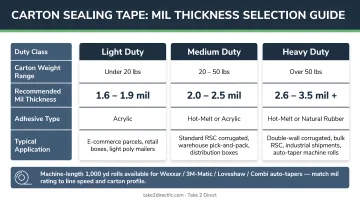
Recycled corrugated may require going one tier heavier than box weight alone suggests — the porous surface reduces effective adhesion on otherwise adequate tape.
Tape Width and Roll Length
Once you've locked in mil thickness, width and roll length determine your actual cost-per-seal — a metric that matters more than price per roll.
- Switching from two strips of 2" tape to a single strip of 3" tape on larger cartons can reduce both material use and application time
- Hand rolls (50–110 yards) are appropriate for lower-volume packing stations
- Machine rolls (900–1,800+ yards) are designed for automated case sealers and reduce changeover frequency
Hand Application vs. Machine Compatibility
Not all tapes are rated for automated case sealer use. Machine-length tapes have specific roll lengths and consistent tension profiles required for reliable feed and cut cycles. Using hand tape on a machine line — or vice versa — can cause jams, mis-cuts, and uneven seals.
Always verify compatibility with your case sealer manufacturer's specs before procurement. The key specs to check: roll length, unwind profile, and tension consistency — not just adhesive type.
Temperature and Corrugated Quality
Two environmental factors that frequently get overlooked can undermine an otherwise correct tape selection:
- Temperature: Identify the coldest point in your supply chain, not just your warehouse. If boxes will travel through refrigerated trucks or cold-storage facilities, select tape rated for that temperature range
- Corrugated quality: High-recycled-content corrugated has a dustier, more porous surface. Standard acrylic tape may not achieve full adhesion on it. Default to hot melt or a high-tack acrylic formulation, and test on your actual box stock before committing to a full order
How We Chose the Best Carton Sealing Tapes
The tapes profiled in this guide were evaluated on:
- Initial tack, shear resistance, and documented temperature range
- Performance on both hand dispensers and automated case sealers
- Adhesion to recycled-content corrugated, now the industry standard for most facilities
- Cost-per-seal efficiency: width, roll length, and waste rates relative to sticker price per roll
Each criterion maps directly to a recurring procurement mistake we see across distribution facilities and 3PL operations:
- Buying tape by price per roll without accounting for roll length or width
- Using consumer-grade tape at industrial packing volumes
- Selecting hot melt tape for cold-chain operations
- Skipping substrate testing before scaling procurement
Conclusion
The best carton sealing tape isn't the cheapest roll — it's the one that matches your box weight, corrugated quality, operating temperature, and throughput method. A misaligned tape choice generates product damage claims, rework labor, and line stoppages that cost far more than a premium tape ever would.
Take 2 Direct carries a full selection of carton sealing tapes: acrylic, hot melt, cold-temp, and water-activated — all available for same-day shipping to distribution facilities, 3PLs, and fulfillment operations across Atlanta, Charlotte, Chicago, Dallas, Denver, Inland Empire, Los Angeles, Minneapolis, NYC, and Savannah. Customers save up to 30% compared to national catalog suppliers.
If you need help matching the right tape to your operation, contact the team directly. With over 100 years of combined supply chain experience, they can work through your specific box weights, environments, and line speeds to get you to the right spec fast.
Frequently Asked Questions
What is the best tape to stick to cardboard?
For industrial corrugated cartons, use acrylic tape for general and long-term applications, or hot melt where aggressive tack is needed on recycled or rough corrugated. Consumer tapes like masking tape or office tape aren't built for the mechanical demands of sealed cartons in transit.
What is the best heavy duty packing tape?
For cartons in the 50+ lb range, look at high-mil hot melt tape (2.5–3.1 mil) or reinforced water-activated tape. Both provide the tensile strength and adhesion needed under heavy load. Mil thickness and adhesive type determine heavy-duty performance, not brand name alone.
What is the difference between acrylic and hot melt carton sealing tape?
Acrylic uses a water-based adhesive with UV resistance, aging durability, and stable performance across temperature swings. Hot melt uses a synthetic rubber adhesive with stronger initial tack and better adhesion on recycled or porous corrugated. Choose based on your substrate and operating environment.
How thick should carton sealing tape be for heavy boxes?
Medium-heavy cartons (up to 80 lbs) typically call for 2.5–3.1 mil tape; higher-stress applications like electronics or hazardous materials warrant 3.4 mil and above. Recycled corrugated may require going one tier heavier than box weight alone suggests, since the porous surface reduces effective adhesion.
Can the same carton sealing tape be used for both hand application and automated case sealers?
Not reliably. Hand tape and machine tape differ in roll length, unwind profile, and tension consistency — using hand tape on a case sealer can cause jams and inconsistent seals. Verify your tape is rated for machine use and matches your case sealer's taping head specs before ordering.