Heat treated (HT) pallets are the globally recognized solution to this problem, required under the ISPM 15 international standard for any wooden packaging material crossing most international borders. This guide covers exactly what heat treated pallets are, how the treatment process works, what the IPPC compliance stamp means, and when your operation needs them.
Key Takeaways
- HT pallets are heated to a minimum core temperature of 56°C (132.8°F) for at least 30 consecutive minutes
- Mandatory for international shipments under ISPM 15, enforced by USDA APHIS and U.S. Customs
- Look for the IPPC stamp with the "HT" code on the pallet stringer to confirm certification
- Not required for domestic U.S. shipments or qualifying U.S.-Canada shipments
- Treatment is permanent for the pallet's lifetime, unless it's repaired with new, untreated wood
What Is a Heat Treated Pallet?
A heat treated pallet — also called an HT pallet or export pallet — is a wooden pallet that has been heated to a minimum core temperature of 56°C (132.8°F) for at least 30 consecutive minutes to eliminate pests, larvae, fungi, and other biological contaminants naturally present in raw wood.
Why Raw Wood Is a Biosecurity Risk
Trees absorb nutrients from soil, water, and air — and in doing so, they're also exposed to insects and pests that can embed deep within the wood. Bark is a particularly common habitat for insect eggs and larvae. When untreated wood travels internationally, those pests can enter destination ecosystems where they have no natural predators, causing significant agricultural and environmental damage.
Wood packaging material (WPM) must meet strict phytosanitary treatment requirements before crossing borders. This applies to more than just pallets — any wood used in international shipping is regulated, including:
- Crates and boxes
- Dunnage
- Drums and wooden barrels
Heat Treatment vs. Methyl Bromide
The older alternative to heat treatment was methyl bromide fumigation, a chemical process that killed pests but carried serious environmental and health consequences. Developed countries phased out controlled uses of methyl bromide by 2005, and developing countries followed by 2015 under the Montreal Protocol.
Heat treatment is now the preferred method. It requires no chemicals, leaves no toxic residue, and delivers the same results.
What Is ISPM 15 and Why Does It Matter?
If your shipment crosses an international border on wood packaging, ISPM 15 (International Standards for Phytosanitary Measures No. 15) determines whether it clears customs or gets seized. Established by the International Plant Protection Convention (IPPC) under the United Nations' Food and Agriculture Organization (FAO), it's the global standard governing how wood packaging materials must be treated before entering another country.
The U.S. began implementing ISPM 15 on September 16, 2005, with full enforcement starting July 5, 2006. The IPPC currently records 89 national implementation entries for ISPM 15, reflecting near-universal adoption across major trading nations.
Who Must Comply
- All international shipments on wooden WPM require ISPM 15-compliant treatment
- Shipments to Mexico are subject to ISPM 15 requirements
- U.S.-Canada shipments are exempt under a bilateral arrangement established in 2005, provided qualifying conditions are met
- Domestic U.S. shipments do not require ISPM 15 compliance
Consequences of Non-Compliance
Non-compliant wood packaging can stop a shipment cold at the port of entry:
- Shipments held at customs pending inspection
- Non-compliant wood quarantined or destroyed by the importing country
- Cargo rejection and return at the importer's expense
- Financial penalties issued against the shipper
Falsifying the ISPM 15 compliance stamp — rather than simply lacking one — carries criminal exposure on top of customs penalties. In a case reported by the DOJ, American Pallet Recycling and its former owner Raymond Viola pleaded guilty to forging heat-treatment certificate stamps. The company paid a $100,000 fine; Viola received a $1,000 fine, three years of probation, and surrendered control of the business. USDA APHIS and U.S. Customs and Border Protection jointly enforce ISPM 15 at ports of entry, with APHIS maintaining an active noncompliant WPM dashboard to track violations.
The Heat Treatment Process: Step by Step
Understanding how HT certification is earned helps buyers verify that what they're purchasing is legitimate.
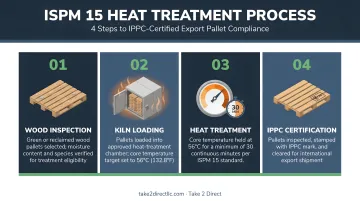
Step 1 — Debarking
The process begins with bark removal. Bark is the primary habitat for insect eggs and larvae, so ISPM 15 requires debarked wood before treatment. That said, ISPM 15 doesn't mandate 100% bark-free wood. Individual bark pieces may remain if each is smaller than 3 cm wide, or if wider than 3 cm, each piece has a total surface area under 50 square centimeters. Debarking typically occurs before pallet construction.
Step 2 — Kiln Heating
Debarked pallets are loaded into a large heat treatment chamber or kiln, arranged to allow proper airflow and even heat distribution throughout the load. The chamber is brought to temperature and held until the internal core of the wood (not just the surface) reaches and sustains 56°C (132.8°F) for a minimum of 30 continuous minutes.
Surface heat alone doesn't meet the standard — pests and larvae can survive deep inside the wood even when exterior temperatures are adequate.
Step 3 — Temperature Monitoring
Temperature probes are inserted into the wood (typically at least 30 cm from the end, drilled into the center mass of the largest components) to confirm that core temperatures were achieved and held throughout the full treatment cycle. This data must be documented and retained for compliance certification.
Step 4 — Inspection and Stamping
After treatment, pallets are inspected against ISPM 15 requirements. Compliant pallets are then branded with the official IPPC mark. This stamp must be clearly visible on the pallet stringer before the pallet is used in any international shipment.
Treatment Longevity and Repair Rules
The heat treatment certification lasts for the lifetime of the original pallet. Repairs and component replacements change that. Specifically:
- If a component is replaced with new, untreated wood, the pallet loses its certification
- The old stamp must be removed or destroyed entirely
- The pallet must undergo full re-treatment and re-stamping before it can be used for export again
- If more than approximately one-third of the pallet's components are replaced, it's classified as remanufactured and must be fully re-treated
How to Read the IPPC Heat Treated Stamp
The IPPC stamp is the globally recognized proof of compliance. It can only be applied under the authority of a national plant protection organization (NPPO). In the U.S., that's USDA APHIS, or an organization officially audited and authorized by the NPPO.
What Each Element of the Stamp Means
| Stamp Element | What It Identifies |
|---|---|
| IPPC wheat-sheaf symbol | Confirms the mark is an official IPPC certification |
| Two-letter ISO country code (e.g., "US") | Country where the treatment was performed |
| Unique producer/certifier number | The specific treatment facility authorized by the NPPO |
| Treatment code ("HT") | Confirms heat treatment was the method used |
Every element matters. The producer number links the pallet to a specific certified facility, which means stamp fraud is traceable and carries real legal consequences.
What to Verify Before Accepting Pallets
Before accepting pallets for an international shipment:
- Visually confirm the HT stamp is present on the pallet stringer
- Verify the treatment code reads "HT" (not "MB" for methyl bromide, which is a different treatment)
- Work only with suppliers whose treatment facilities are audited and certified by an accredited third-party inspector
- For recycled pallets, confirm no components have been replaced with unstamped wood
Benefits of Heat Treated Pallets Beyond Compliance
ISPM 15 compliance is the primary reason most businesses source HT pallets, but the treatment delivers additional practical value.
Moisture Reduction and Durability
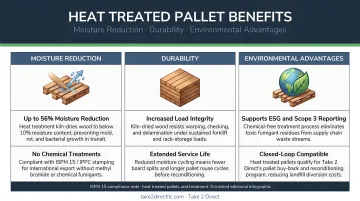
The heating process drives moisture out of the wood. Kiln-dried HT pallets can reach moisture content of 19% or lower, making them less susceptible to warping, cracking, mold, and rot. Drier, more stable pallets hold up better across multiple shipment cycles.
Product Protection in Sensitive Industries
Moisture-laden, untreated pallets can harbor mold or bacteria that can contaminate goods in food, beverage, pharmaceutical, and agricultural shipments. HT pallets reduce that risk. FDA FSMA doesn't specifically mandate ISPM 15 for domestic food transport, but the pest-free, lower-moisture profile of HT pallets aligns well with sanitary handling requirements across these sectors.
Reuse and Environmental Advantages
Heat treatment uses no chemicals, so HT pallets carry no toxic residue — making them safer to handle and compatible with food-adjacent environments. They can also be reused multiple times, reducing demand for new timber and cutting the overall cost per shipment cycle.
When Do You Need Heat Treated Pallets?
You need HT pallets for any international shipment. If wooden WPM is leaving the U.S. destined for another country — including Mexico — it must be ISPM 15 compliant. This rule applies regardless of what you're shipping.
Domestic operations have good reasons to use them too:
- Food and pharmaceutical warehousing requires pest-free, hygienic storage environments
- Long-term storage increases untreated wood's exposure to mold and pest infestation
- Agricultural distribution often carries additional plant protection requirements beyond standard ISPM 15
If you're sourcing HT pallets, Take 2 Direct carries them in standard 48x40, Euro, and custom sizes — new and recycled — across 10 U.S. markets including Atlanta, Chicago, Dallas, Los Angeles, and Savannah. With over 100 years of combined supply chain experience, the team works with distribution facilities, 3PLs, and Fortune 500 operations to match the right pallet spec to your export requirements.
Frequently Asked Questions
What are heat treated pallets?
Heat treated pallets are wooden pallets heated to a minimum core temperature of 56°C (132.8°F) for at least 30 continuous minutes to eliminate pests, larvae, and fungi. This process makes them ISPM 15 compliant and safe for use in international shipments.
What are the regulations for heat treated pallets?
ISPM 15 requires all wood packaging materials used in international trade to be heat treated (or fumigated) and stamped with an official IPPC compliance mark. In the U.S., USDA APHIS and U.S. Customs and Border Protection jointly enforce compliance at ports of entry.
Can heat treated pallets get wet?
Heat treatment reduces moisture content but does not make pallets waterproof. If HT pallets absorb water after treatment, they can become susceptible to mold or warping. The ISPM 15 certification stays valid as long as no new wood is added to the pallet.
How long does heat treatment last on a pallet?
Heat treatment is permanent for the life of the original pallet. Once stamped, no re-treatment is needed unless the pallet is repaired with new wood.
Do heat treated pallets need to be re-treated after repair?
Yes — replacing any component with new wood voids the ISPM 15 certification. The original stamp must be permanently obliterated, and the pallet must undergo full re-treatment and re-stamping before it can be used in international shipping again.
What happens if my shipment uses non-compliant pallets?
Non-compliant pallets can get your shipment held at customs, quarantined, returned, or destroyed by the importing country. Repeated violations or stamp falsification also carry serious legal penalties, including fines and criminal charges.