That math is getting harder to defend. Regulatory pressure from state EPR legislation, sustainability requirements from major retail partners, and internal ESG commitments are pushing operations teams to find alternatives that actually work — not just alternatives that look good on paper.
The good news: the market has caught up. Paper-based wrap, compostable film, recycled-content stretch film, and reusable systems have all matured to the point where "sustainable" no longer means "weaker." This article breaks down each option, how they perform, and how to choose the right one for your operation.
Key Takeaways
- Stretch wrap recycling rates in the US hover around 21% — the vast majority ends up in landfill
- The main alternatives are paper-based wrap, compostable film, recycled-content film, and reusable systems
- Performance gaps between eco-friendly and conventional wrap have largely closed
- The right choice depends on load type, volume, and local disposal infrastructure
- Most sustainable options fit existing workflows without major operational changes
Why Traditional Stretch Wrap Is a Problem Worth Solving
LLDPE stretch film became the default pallet-securing solution because it's cheap, flexible, and works on nearly any load. The end-of-life story is a different matter.
The Recycling Partnership reported in 2021 that only 1% of US households can recycle film at home, and that film and flexible packaging requires major system changes just to reach a 30% recycling rate. Most commercial stretch wrap that isn't actively collected ends up in landfill, where it breaks down slowly and contributes to microplastic accumulation in soil and water systems.
The Regulatory and Customer Pressure Is Real
Beyond environmental impact, the business risk dimension is accelerating:
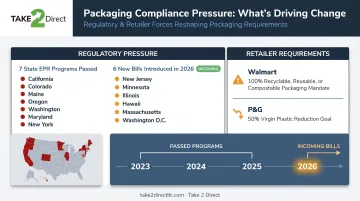
- 7 US packaging EPR bills have already passed, with 6 more states introducing new legislation in 2026 — California, Colorado, Maine, Oregon, and Washington among the most active (per the Sustainable Packaging Coalition)
- Walmart requires 100% of private-brand packaging to be recyclable, reusable, or industrially compostable; P&G has committed to a 50% reduction in virgin petroleum plastic by 2030
- Suppliers and logistics partners using virgin LLDPE film face growing scrutiny from both regulators and the CPG and retail customers setting their own packaging benchmarks
For distribution operations and 3PLs supplying these retailers, the question is shifting from whether to transition away from conventional film — to which alternatives actually hold up under real warehouse and transit conditions.
The Main Types of Sustainable Pallet Wrap Available Today
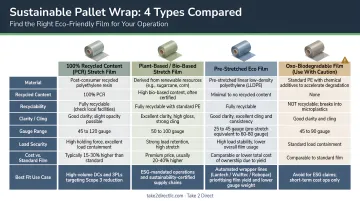
Four categories of sustainable pallet wrap are commercially available and operationally proven. Each suits different needs.
Paper-Based (Kraft) Pallet Wrap
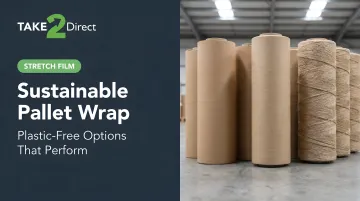
Paper wrap — such as HexcelStretch by HexcelPack and PaperWrap by Ranpak — uses slit kraft paper engineered into a honeycomb-like structure that provides stretch and cling through physical design rather than plastic polymers.
Key attributes:
- 100% curbside recyclable and compostable at end of life
- Made from renewable resources, no petroleum polymers
- HexcelPack claims load stability for pallets up to 5,400 lb with 30% better stability than plastic (manufacturer claim; not independently verified)
- Machine throughput ranges from 25–90 pallets/hour depending on equipment configuration (manufacturer specifications from HexcelPack and Ranpak)
Best fit: operations where recyclability at destination is a priority and load profiles are relatively uniform.
Compostable Pallet Wrap Film
Compostable stretch films are made from biopolymers derived from plant-based oils, agroforestry waste, and food-processing byproducts. They look and feel similar to conventional stretch film but are designed to break down under industrial composting conditions.
One important distinction: compostable ≠ biodegradable. Under FTC Green Guides, a compostable claim requires that all materials break down into usable compost in a safe and timely manner. For most compostable pallet films, that means industrial or in-vessel composting at elevated temperatures. Curbside bins and general waste don't qualify.
What that means operationally:
- BioCycle's 2023 survey found 200 full-scale US food-waste composting facilities, with 71% accepting compostable food-contact packaging
- Businesses need confirmed access to an industrial composting facility before committing to this material type
- The CHEP/Microsoft SWAP project found compostable PBAT film passed ISTA 3E transit testing but proved difficult to run on high-speed automatic pallet wrapping equipment
Best fit: operations with established composting infrastructure and hand-wrap or semi-automatic application.
Recycled-Content Stretch Film
Recycled-content film looks, feels, and applies exactly like conventional stretch wrap, with 30–100% post-consumer recycled LLDPE content instead of virgin polymer. Products from suppliers including EcoEnclose (25% PCR), ExxonMobil (up to 30% PCR), Sigma (up to 75% recycled content), and Grounded (30% or 100% PCR) are available at commercial scale.
Performance claims from multiple manufacturers indicate equivalent containment force, puncture resistance, and pre-stretch ratios to virgin film — though these are supplier specifications rather than independent benchmarks.
End of life: Clean PCR film is eligible for store drop-off programs (per How2Recycle) and commercial recycling through programs like NexTrex, which accepts stretch film, shrink wrap, and pallet wrap from commercial generators.
Best fit: the lowest-friction transition for any operation already running machine wrappers. No equipment changes, no new application training, no operational disruption.
Reusable Pallet Wrap Systems
Reusable options — pallet nets and reusable hoods — replace single-use wrap entirely. Each cover ships with the pallet and returns for reuse, eliminating per-pallet consumable cost entirely.
The CHEP/Microsoft SWAP LCA found that reusable pallet protection becomes more environmentally beneficial than hand-applied LLDPE stretch wrap after approximately 50 uses, assuming a 95% return rate. Reusable covers are designed for up to 2,500 uses (roughly 3 to 4 years), and the same SWAP project reported Cisco's covers were still in rotation five years after introduction.
Upfront cost for a reusable cover runs approximately $150 per unit. The tradeoff is near-zero consumable spend over the product's lifespan, though reverse logistics and storage requirements are real operational considerations.
Best fit: closed-loop supply chains, high-frequency routes, or operations with control over pallet return.
Do Sustainable Alternatives Actually Perform?
The performance concern is legitimate — and it's the most common reason operations teams delay switching. Here's what the evidence shows.
Load Stability and Holding Strength
- Recycled-content film: Atlantic Packaging states its 18% PCR film matches virgin film on containment, puncture resistance, tear, and ultimate stretch. ExxonMobil reports maintained mechanical performance at up to 30% PCR. These are manufacturer claims, but multiple suppliers report the same result — and drop-in machine compatibility means real-world testing is straightforward.
- Paper-based wrap: Load stability comes from the honeycomb structure, which provides multi-directional resistance. HexcelPack's published load figures are manufacturer claims without independent verification — request a sample test on your actual load profile before relying on the spec sheet.
- Reusable hoods: The SWAP project reported the reusable hood passed transit testing and protected the pallet load against damage in live conditions.
Machine Compatibility and Application Speed
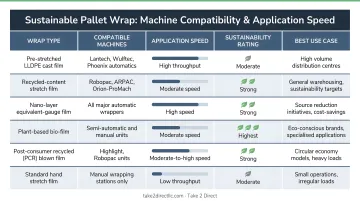
| Wrap Type | Machine Compatibility | Speed (Manufacturer Data) |
|---|---|---|
| Recycled-content film | Drop-in compatible with existing stretch wrappers | Matches conventional film |
| Compostable PBAT film | Difficult in high-speed automatic equipment; better for hand wrap | Hand application ~3 min/pallet |
| Paper-based wrap | Requires compatible equipment | 25–90 pallets/hour depending on model |
| Reusable hood/net | Different application process; no wrapping machine needed | Variable |
Real-World Durability
Lab performance matters, but transit performance is what protects product. The SWAP case study found compostable film passed ISTA 3E transit testing despite some application challenges, and reusable hoods passed as well. These are project-reported results, not independently published lab certificates — so treat them as a starting point, not a guarantee.
That's exactly why piloting before full deployment is the right move. Request samples, run them on one shift and one product line, then evaluate the results in your own facility. That data will tell you more than any spec sheet.
How to Choose the Right Sustainable Pallet Wrap for Your Operation
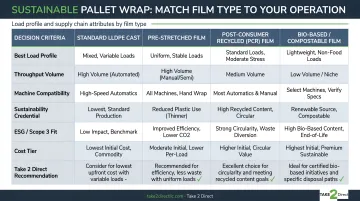
No single option wins across all use cases. These four factors should drive your decision.
Match the Wrap Type to Your Load Profile
Stretch wrapping practitioners categorize loads by difficulty — from uniform "A" loads to irregular "C" loads with protrusions, voids, or sharp edges. This matters when selecting wrap material:
- Heavy, irregular C loads: Paper-based wrap's structural strength or a reinforced high-PCR film is worth evaluating
- High-volume machine wrap with existing equipment: Recycled-content film is the clear starting point — no disruption, immediate impact
- Closed-loop supply chains: Reusable systems offer the best long-term environmental and cost performance
- Operations with composting access: Compostable film is viable, but verify facility acceptance before committing
Consider Your Disposal Infrastructure First
"Sustainable" is only half the equation if the wrap can't be properly disposed of at end of life. Before selecting a material type:
- Compostable film: Confirm access to an industrial composting facility that accepts flexible packaging
- Recycled-content PCR film: Identify store drop-off partners or set up in-facility baling for clean film collection
- Paper wrap: Curbside recyclable in most markets or baled for resale — typically the most accessible end-of-life path
- Reusable systems: Requires reverse logistics infrastructure and storage space for covers between uses
Map your local disposal options before you decide on material type. Municipal composting acceptance lists and your regional film recycler's drop-off requirements are the two most common places the decision breaks down — check both early.
Factor In Total Cost, Not Just Unit Price
Per-roll cost is rarely the right comparison metric. Consider:
- Compostable film costs roughly 100% more per kilogram than conventional virgin LLDPE, per the CHEP SWAP report
- High-performance PCR film may use less material per pallet due to improved pre-stretch ratios, reducing actual spend per pallet
- Reusable covers at ~$150/unit look expensive until you model consumable spend eliminated over 2,500 uses
- Paper wrap eliminates plastic disposal costs and potential EPR compliance fees
Build a per-pallet total cost model — including material, disposal, labor, and any compliance risk — before drawing conclusions from roll price alone.
Evaluate Supplier Reliability
Sustainable wrap options vary considerably in availability and sourcing predictability compared to commodity LLDPE film. Take 2 Direct stocks over 20,000 packaging and supply items with same-day shipping across 10 US markets — Atlanta, Charlotte, Chicago, Dallas, Denver, Inland Empire, Los Angeles, Minneapolis, NYC, and Savannah. The company also runs post-industrial plastic film recycling operations, which can support the end-of-life piece of a recycled-content or conventional film transition. For current sustainable product specs and volume pricing, their team can provide quotes specific to your market.
Making the Switch: Practical Steps
Switching wrap materials doesn't require a facility-wide overhaul. A structured approach reduces risk and builds internal confidence.
Start with a pilot — Pick one product line, one shift, or one facility. Run the sustainable wrap in real operational conditions for 2–4 weeks before scaling. This generates internal performance data and surfaces any application issues early.
Establish your baseline first — Document your current roll consumption per week, unit cost, and disposal method. Without a baseline, you can't measure the impact of switching or make a credible internal business case.
Don't skip worker training — Different materials have different application characteristics. Paper wrap handles differently than LLDPE. Compostable film can tear if applied with the same tension settings. A 30-minute floor orientation prevents early-adoption mistakes from being misread as material failures.
Verify disposal infrastructure in your market — Contact local composting facilities, confirm store drop-off locations for PCR film, or inquire with your packaging supplier about film recycling buyback options before finalizing material selection.
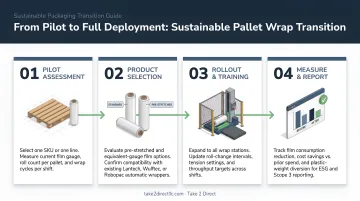
Following these steps in sequence keeps the transition manageable. Most operations that pilot before scaling report fewer disruptions and stronger buy-in from warehouse staff — two factors that determine whether a sustainable wrap switch actually sticks.
Frequently Asked Questions
Frequently Asked Questions
What is an eco-friendly alternative to plastic wrap?
The main categories are paper-based kraft wrap, compostable bio-film, recycled-content stretch film (30–100% PCR), and reusable pallet nets or hoods. Each suits different operational contexts. Recycled-content film is the easiest drop-in replacement; reusable systems deliver the best long-term impact in closed-loop supply chains.
Is compostable pallet wrap as strong as traditional stretch wrap?
Compostable films have passed ISTA 3E transit testing under controlled transit conditions and perform adequately for many applications. The main limitations are compatibility with high-speed automatic wrappers and the requirement for industrial composting at end of life — home or curbside composting won't work for most commercial films.
Can sustainable pallet wrap be used with existing stretch wrap machines?
Recycled-content film is the most straightforward drop-in replacement — same equipment, same process. Paper-based wrap requires compatible equipment and a different application method. Compostable PBAT film works better with hand or semi-automatic wrap than with high-speed machine application.
How much does sustainable pallet wrap cost compared to regular stretch wrap?
Per-roll prices can be higher, particularly for compostable film, which runs roughly double the cost per kilogram of virgin LLDPE. However, total per-pallet cost (factoring in material efficiency, disposal savings, and reduced EPR compliance exposure) often brings sustainable options to cost parity or better, especially at volume.
What industries benefit most from switching to sustainable pallet wrap?
Any industry using palletized shipping benefits, but the most immediate pressure falls on food and beverage, CPG, retail distribution, and 3PLs with sustainability-conscious retail partners. These sectors face the earliest exposure to retail supplier sustainability mandates and state EPR requirements.
Are there regulations requiring businesses to use sustainable packaging materials?
No federal mandate specifically targets B2B stretch wrap yet. However, seven US state packaging EPR programs have passed, with more active in 2026. Major retailers like Walmart and Target are also imposing supplier sustainability requirements, making the switch a practical necessity for companies in those supply chains.