The good news: pallet wrap is recyclable. The caveat is that it cannot go in your standard recycling bin, and whether it actually gets recycled depends entirely on how it's prepared, collected, and routed. Get those steps wrong, and you're just moving contaminated plastic from one waste stream to another.
This guide covers what pallet wrap is made of, how to recycle it correctly, and what's standing between your used film and a legitimate second life.
Key Takeaways
- Pallet wrap is made from LLDPE (resin code #4) — recyclable, but not through curbside or single-stream programs
- Flexible plastic film jams MRF sorting equipment, so it must go through specialized film recycling channels
- Recyclers require film to be clean, dry, and free of tape, labels, and grease
- Bale your film before pickup — commercial recyclers reject loose material
- Cutting film usage per pallet matters as much as recycling what remains
What Is Pallet Wrap Made Of?
Pallet wrap — also called stretch film or stretch wrap — is primarily made from Linear Low-Density Polyethylene (LLDPE). Some formulations incorporate Low-Density Polyethylene (LDPE). Both fall under plastic resin code #4 and are technically recyclable.
Why LLDPE Dominates
Standard LDPE works, but LLDPE's molecular structure makes it better suited for load unitization. Dow's material documentation describes LLDPE as offering high tensile strength, puncture resistance, and elongation — qualities that let thinner gauges secure heavier loads without tearing. That combination of strength and stretch is what made it the industry standard.
Cast vs. Blown Film
How the film is made affects its properties:
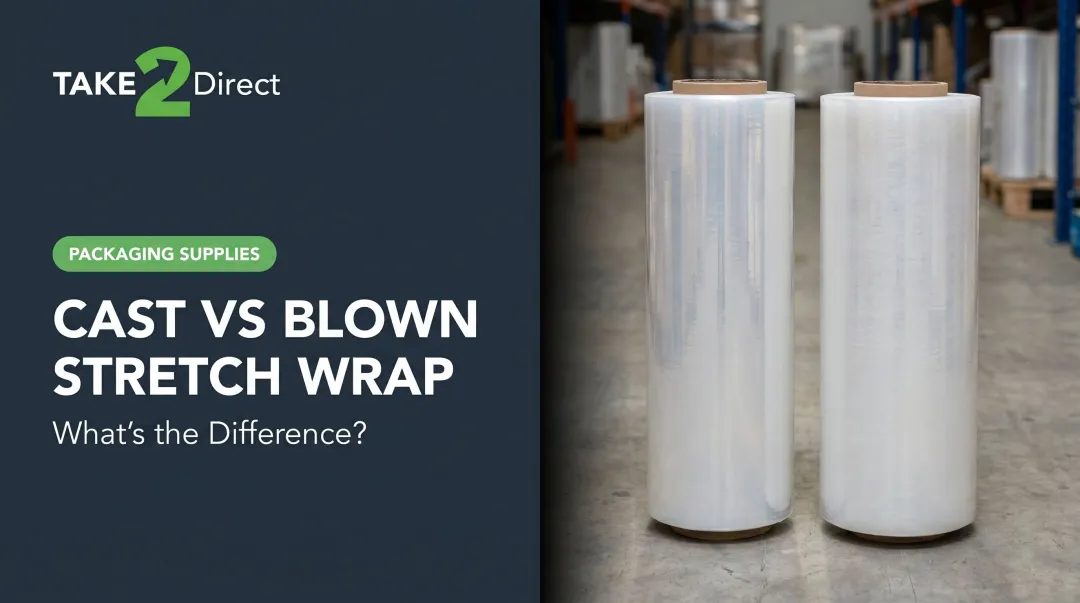
- Cast extrusion — Molten resin is extruded through a flat die and cooled on a chilled roll. Produces clearer film with consistent gauge and quiet unwind. Most hand wrap and machine film falls into this category.
- Blown extrusion — Resin is pushed through a circular die and inflated into a tube. Produces tougher, more opaque film with greater puncture resistance, better suited to sharp-edged or irregular loads.
Both processes produce LLDPE film that ends up as resin code #4.
Additives and Recyclability
Most common additives — UV stabilizers, anti-static agents, slip agents, and tackifiers — are classified as acceptable for PE film recycling by the Association of Plastic Recyclers (APR), provided they don't disrupt processing. A few flags worth noting:
- Dark pigments can be detrimental to recycling quality, though some facilities accept them or process them separately
- Degradable additives (oxo-degradable or compostable) are not recyclable through standard PE film programs
- Metallic pigments require testing before they're accepted
- Heavy additive loading that makes film sink in water causes material loss during washing
Colored stretch film — including the kind stocked by Take 2 Direct for color-coded load identification — may face more scrutiny at some recycling facilities. Clean, clear, or natural film is the simplest to recycle.
Is Pallet Wrap Recyclable?
Yes. But the channel matters enormously.
Why It Can't Go in the Bin
According to Closed Loop Partners' Film Recycling Investment Report, thin polyethylene film wraps around rotating screen shafts inside materials recovery facilities (MRFs), fouling equipment and creating manual removal risks. In baseline MRF testing, 88% of flexible plastic packaging by weight flowed into fiber streams — contaminating paper bales rather than getting sorted for recycling. Film that enters single-stream almost always ends up in a landfill.
The Correct Channel
Clean, uncontaminated stretch film must go through one of these routes:
- Drop film at participating retailers (Kroger, Whole Foods, Wegmans, Meijer, Albertsons) through How2Recycle's Store Drop-off program — covers clean, dry #2 and #4 PE films; availability varies by location
- Ship directly to commercial film recyclers like NexTrex, which accept industrial stretch film, pallet wrap, and shrink wrap — material must be clean and dry
- Partner with a regional plastic film broker or waste broker for higher-volume operations, which is typically the most cost-effective route at scale
What Happens to Recycled Film?
Once a recycler receives the film, it's cleaned, dried, and fed through a compounding system that converts it back into LLDPE pellets. Those pellets go into manufacturing:
- New stretch film rolls (post-industrial recycled content)
- Trash can liners and bin bags
- Composite lumber and decking
- Injection-molded products like pallets and crates
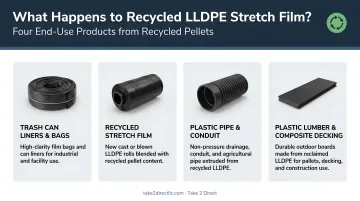
The Closed Loop report specifically flags trash bags and thicker-gauge commercial films as the most common end markets for collected warehouse film — meaning the material your operation generates can realistically re-enter the supply chain rather than the landfill.
How to Recycle Pallet Wrap: Step-by-Step
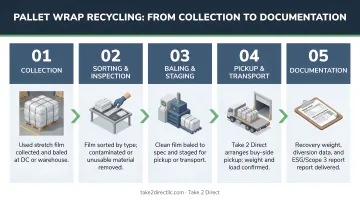
Step 1: Collect and Clean
Gather used film systematically across the facility as pallets are unwrapped. Before anything goes into your collection bin, it must be:
- Free of dirt, grease, and moisture
- Stripped of adhesive tape and labels
- Clear of food residue or product contact
Contamination is the single most common reason film gets rejected at recycling facilities. The APR's PE Retail Mix Film bale specification sets total contamination at no more than 10% by weight, with tape and cardboard each capped at 2%. Even a small amount of the wrong material can downgrade or disqualify an entire bale.
Step 2: Segregate From Other Waste Streams
Stretch film must be kept separate from:
- Cardboard and paper
- Shrink wrap (keep in a separate bale where possible)
- HDPE bags or other non-PE plastics
- Strapping and packaging tape
Set up clearly labeled bins dedicated solely to clean stretch film. Mixed bales reduce value — and some buyers won't accept them.
Step 3: Bale the Film
Loose film is not accepted by most commercial recyclers. A stretch film baler compresses collected film into dense, manageable bales that meet the weight and density requirements for commercial pickup.
Bale size and weight thresholds vary by recycler. Confirm specifications before your first pickup to avoid a rejected load.
Step 4: Partner With a Film Recycler or Broker
Identify a local or regional plastic film recycler, or work through a broker who handles LLDPE stretch film. Take 2 Direct's post-industrial recycling program buys and sells plastic film across all 10 of its US service markets. For operations already sourcing stretch film through Take 2 Direct, consolidating supply and recycling under one partner simplifies logistics.
Clean, well-sorted bales also have real financial upside:
- Some recyclers waive pickup fees once volume thresholds are met
- High-purity LLDPE bales can earn payment per pound or per ton, depending on current commodity pricing
Step 5: Track and Document
Operations with sustainability reporting or ESG commitments should track:
- Volume of film diverted (pounds or tons per period)
- Recycler certifications and facility details
- Chain-of-custody records
This documentation supports both internal reporting and third-party compliance requirements.
What Makes Pallet Wrap Difficult to Recycle?
Contamination
This is the biggest barrier. The following will get a bale rejected:
- Adhesive tape and packing straps
- Pressure-sensitive labels that can't be removed
- Grease, oil, or moisture
- Food residue
- Hazardous material exposure
There's no workaround here. Contaminated film costs more to process than it's worth, so recyclers simply turn it away.
Thin Film and Equipment Incompatibility
Standard MRF equipment isn't built for material under roughly 10 mils thick. Thin PE film tangles around conveyor shafts and auger screens, creating a safety hazard that most facilities can't absorb operationally.
This isn't a sorting problem — it's a hardware problem. Film recycling requires specialized equipment, which is why it operates on a completely separate infrastructure track from standard curbside recycling.
Infrastructure Gaps
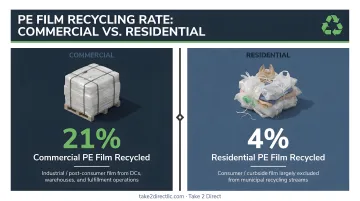
Commercial PE film recycling performs meaningfully better than residential — Closed Loop Partners estimated a 21% recycling rate for commercial film versus 4% for residential. But the gap between available material and processing capacity remains significant. Not every market has accessible film recyclers, and bales containing mixed PE grades (LLDPE, LDPE, HDPE) may require additional sorting by the buyer, reducing value or triggering rejection in some cases.
How to Reduce Pallet Wrap Waste at Your Facility
Recycling is the right move, but reducing film consumption upfront cuts costs even further. Three areas offer the most direct impact:
Optimize Wrapping Technique
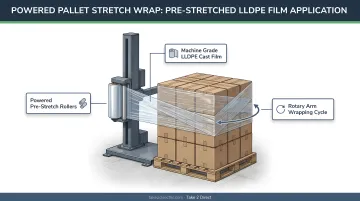
Pre-stretch ratios directly affect how much film gets used per load. According to Lantech, common pre-stretch settings range from 150% to 300%, meaning each foot of film from the roll covers 2.5 to 4 feet of load surface.
Powered pre-stretch delivery systems can cut film costs by at least 50% compared to hand wrapping. One Lantech customer example projects over $50,000 in film savings across 10 years on 50 loads per day.
Source Higher-Performance Film
Thinner, high-tensile LLDPE films hold just as well with fewer layers. Matching the right film specification to your load type — weight, edge profile, transit distance — eliminates over-wrapping that inflates both usage and cost.
Take 2 Direct stocks machine grade, hand wrap, extended core, and pre-stretch film options, with pricing up to 30% below national catalog suppliers.
Audit Your Current Usage
Track film consumption per shift, per line, or per pallet SKU. Common patterns to watch for:
- One line consistently overusing film relative to others
- Shift-to-shift inconsistency in wrap counts or techniques
- Specific product types requiring a different gauge than your current stock
Once you can measure where the waste originates, you can address it directly.
Frequently Asked Questions
Can pallet wrap go in the recycling bin?
No. Flexible plastic film jams sorting equipment at materials recovery facilities and will end up in a landfill if placed in single-stream recycling. Route clean stretch film to a store drop-off program or a commercial plastic film recycler instead.
What recycling number is pallet wrap?
Pallet wrap is resin code #4 (LDPE/LLDPE). Code #4 film is technically recyclable, but it's not accepted in most US curbside programs — it requires a dedicated plastic film collection channel.
Can you recycle pallet wrap that still has tape on it?
Tape and adhesive residue must be removed before recycling. Both are classified as contaminants under commercial bale specifications, and even small amounts can downgrade or disqualify a bale.
What is recycled pallet wrap turned into?
Recycled LLDPE stretch film is processed into pellets and used to manufacture new stretch film, trash can liners, composite lumber, decking, and injection-molded products like pallets and storage crates.
Can businesses get paid for recycling pallet wrap?
Yes. Some plastic film recyclers and brokers pay per pound or per ton for clean, presorted, properly baled LLDPE stretch film. Payment depends on volume, bale purity, and current commodity pricing for recycled plastic resin.
Is stretch film the same as shrink wrap, and are both recyclable?
They're different materials applied differently — stretch film is applied under tension, shrink wrap is applied loosely and heat-shrunk. Both are polyethylene-based and recyclable through plastic film programs, and APR's commercial bale specification allows them in the same bale.