Introduction
Ordering the wrong Gaylord box creates problems that show up fast: the liner doesn't fit, the pallet overhangs, or workers can't safely reach the bottom. What looks like a simple size decision involves at least four interdependent specs — footprint, height, wall count, and internal dimensions.
A Gaylord box is a large corrugated bulk container designed to sit on a pallet, used across manufacturing, recycling, distribution, and 3PL operations for moving and storing high-volume materials.
48" × 40" × 36" is the most common configuration, but it's far from the only option. Defaulting to it without verifying your requirements creates problems downstream.
This guide covers what the dimensions actually mean, the key size variants, how wall count determines weight capacity, and a practical framework for matching specs to your operation.
Key Takeaways
- The most common size is 48" × 40" × 36", matched to the standard GMA pallet footprint
- Height selection should follow your loading method — not just your volume target
- Wall count sets weight capacity — footprint and height alone won't tell you that
- Always confirm internal dimensions — triple-wall construction reduces usable interior space
- No universal standard exists — footprint, height, and wall count must all align for your application
What Gaylord Box Dimensions Actually Mean
Gaylord box dimensions are expressed as Length × Width × Height in inches. The footprint (L × W) determines whether the box fits your pallet and slots into your racking geometry. Height determines cubic volume and, just as importantly, whether your team can safely load and pick from it.
External vs. Internal: The Spec That Actually Matters
The most misunderstood aspect of Gaylord sizing is the gap between external and internal dimensions. The corrugated walls consume space — and that gap grows with wall count.
For example, Uline's 48" × 40" × 36" triple-wall Gaylord has internal dimensions of 46¾" × 38¾" × 36" — over an inch smaller on both length and width. If you're spec'ing a liner or insert to fit flush, those 1¼" differences matter.
Two rules to keep straight when reading spec sheets:
- FEFCO standard: The FEFCO International Fibreboard Case Code defaults to internal measurements for corrugated box dimensions
- U.S. supplier practice: Many domestic suppliers list external dimensions instead — always confirm which convention a spec sheet uses before ordering
Where the Name "Gaylord" Comes From
The term traces back to the Gaylord Container Corporation, one of the early manufacturers of pallet-scale bulk corrugated containers. Over time, "Gaylord" became a generic industry descriptor and now applies to any large corrugated bulk container designed to sit on a pallet.
Standard Gaylord Box Sizes at a Glance
Two variables define Gaylord sizing: footprint and height. Both need to work with your pallet, your rack, and your loading process — and the right combination is more constrained than it looks.
Common Footprints and What They're Used For
| Footprint | Best For | Notes |
|---|---|---|
| 48" × 40" | General warehousing, distribution, recycling | Matches GMA pallet; broadest supplier inventory |
| 45" × 45" | Bulky or irregular-shaped materials | Square format provides extra interior width |
| 36" × 36" | Lighter loads, space-constrained facilities | Compact footprint; more units per trailer |
The 48" × 40" footprint dominates for a reason: it matches the GMA pallet, which pallet suppliers confirm is the most commonly used pallet size in the U.S. This means maximum compatibility with forklifts, pallet jacks, and standard trailer configurations. Unless your racking geometry or product shape requires otherwise, this is the default starting point.
When material doesn't pack efficiently into a rectangular footprint, the 45" × 45" square format solves the problem. Irregularly shaped industrial parts or bulky textiles tend to fill this format more cleanly, with less wasted interior space.
The 36" × 36" option fits where floor space is tight and loads are lighter. Its smaller footprint lets you stage more units per row, and the reduced per-box weight makes manual handling more manageable.
Height Ranges and How to Match Them to Loading Method
Height selection is a loading method decision first, a volume decision second.
Low-profile (24"–30"): Best for line-side operations, frequent pick environments, and anywhere workers are repeatedly reaching into the box. Shorter walls mean less bending and less risk of musculoskeletal strain. NIOSH ergonomic guidance specifically cautions against deep bins that require workers to bend and reach toward the bottom.
Standard (36"–42"): The practical middle ground for most warehousing, recycling, and manufacturing applications. Tall enough for solid volume capacity, short enough for reasonable manual access. The 48" × 40" × 36" configuration sits squarely in this range and covers the majority of general-purpose use cases.
Tall (45"–60"): Built for forklift- or conveyor-assisted loading, where maximizing cubic capacity per container is the priority. A 60"-tall Gaylord can hold 40–50% more volume than a standard 36" box, which cuts total container count and reduces freight trips.
The tradeoffs are real, though: stack stability decreases at taller heights, and dock door clearance needs to be confirmed before specifying these in any facility.
Wall Construction and Weight Capacity
Wall count is the structural spec most buyers underestimate — or skip entirely. It's the variable that determines how much a Gaylord box can safely hold, and it operates independently from footprint and height. A tall 48" × 40" × 48" box and a shorter 48" × 40" × 36" box made from the same wall construction have the same load-bearing characteristics. Size doesn't equal strength.
How Wall Count Works
Each additional wall layer adds a corrugated fluting layer to the box panel, increasing rigidity and compressive strength. This is why two boxes with identical external dimensions can have very different weight ratings.
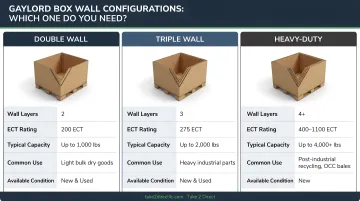
Wall count configurations and their typical applications:
- Double-wall (2-wall): Light-duty use — loose, low-density materials where structural load is minimal. Common for lightweight dry goods or packaging materials.
- Triple-wall (3-wall): The standard for most warehousing and distribution operations. Smurfit Westrock classifies triple-wall as heavy-duty 7-ply corrugated board. The Uline 48" × 40" × 36" triple-wall box carries a 1,500 lb weight capacity with a 1,100# TW/ECT-90 test rating — a solid reference point for medium-density industrial materials.
- 4-wall and 5-wall: Heavy industrial territory — metal scrap, dense plastics, aggregates, and applications with rough handling or stacked storage. Capacities are SKU-specific and vary by manufacturer; always request the rated capacity from your supplier.
Wall Count, Height, and Freight Economics
Higher wall counts support double-stacking in trailers, which has a direct effect on freight economics. A taller, structurally sound Gaylord that can be double-stacked means more product per load without adding truck trips.
That said, always verify stack height with your carrier. Trailer interior heights on a standard 53-foot dry van run approximately 108"–110" per Hale Trailer specifications, meaning two stacked Gaylords plus pallet height can approach that limit quickly with taller box configurations.
How to Choose the Right Gaylord Box Size for Your Operation
Work through these four questions in sequence. Skipping any of them is where sourcing mistakes originate.
Step 1: Identify Your Product Profile
Start with the material itself:
- Dense or heavy? You'll need higher wall counts — don't assume triple-wall is sufficient without checking the rated capacity against your actual load weight
- Irregular geometry? Consider whether a square footprint (45" × 45") fills more efficiently than a rectangular one
- Flowable materials (powder, granules)? A liner will be required — factor internal dimensions into liner sizing from the start
- Rigid or stackable product? Confirm whether dividers or inserts are needed, and size the box around the insert dimensions, not the other way around
Step 2: Select Height Based on Loading Method
| Loading Method | Recommended Height Range |
|---|---|
| Manual hand-loading, frequent picks | 24"–36" |
| General warehousing, mixed methods | 36"–42" |
| Forklift or conveyor-assisted | 45"–60" |
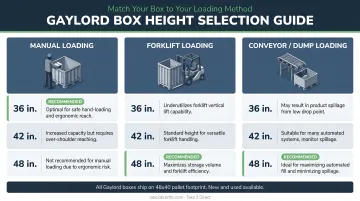
If your team manually loads and picks from these boxes, keep height at or below 36"–40". Taller boxes create reach-and-bend exposure that compounds over a shift. Forklift-loaded environments unlock the taller range without the ergonomic tradeoff.
Step 3: Confirm Internal Dimensions and Pallet Compatibility
Request internal dimensions explicitly from your supplier. As shown earlier, a triple-wall 48" × 40" box loses more than an inch on each interior dimension. That gap matters when:
- Fitting a poly liner that must sit flush without bunching
- Stacking product layers that need clean horizontal clearance
- Ensuring the box footprint doesn't overhang your pallet edges
Confirm the box fits your specific pallet size. A 48" × 40" Gaylord on a non-standard pallet can shift during transport, creating a safety and damage exposure.
Step 4: Validate Against Facility and Transport Constraints
Before finalizing specs, check:
- Rack slot height — box height plus pallet (typically 5"–6") must clear your rack opening
- Doorway clearances — critical for tall configurations moving through dock doors
- Carrier stack height policies — your freight carrier may have explicit limits on loaded pallet height
- Trailer interior height — see the double-stacking note above
Once your checklist is complete, Take 2 Direct's packaging team can help verify specs or compare configurations before you commit to a volume order. They stock both new and used Gaylord boxes, with over 20,000 packaging items available for same-day shipping across 10 major US markets.
Common Mistakes When Selecting Gaylord Box Dimensions
Treating External Dimensions as Usable Space
This is the most frequent sourcing error. A buyer sees "48 × 40 × 36" and assumes those are the interior working dimensions. For double- or triple-wall boxes, they're not. Order liners or inserts based on external dimensions and they'll either be too large to fit flat or too small to protect the contents properly. Always build your interior fitment specs from confirmed internal dimensions.
Choosing Height Based on Volume Alone
Volume targets matter, but they're not the only variable. A buyer targeting maximum cubic capacity selects a 54" or 60" Gaylord, then discovers their floor workers can't safely reach the bottom during loading — or that forklift clearance in the facility doesn't accommodate the fully loaded height.
Match height to your actual loading method first, then confirm it delivers sufficient volume.
Ignoring Wall Count Because the Size Looks Right
Footprint and height are visible. Wall count isn't. Buyers who specify size without specifying wall count often end up with boxes that look correct but fail under load. Common failure modes include:
- Crushed during stacked storage
- Sagging on the pallet under distributed weight
- Collapsing mid-transit when walls can't handle dynamic stress
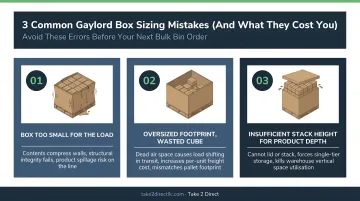
Weight capacity is a wall-count specification. Confirm it alongside the dimensional spec — not after the order ships.
Frequently Asked Questions
What size is a standard Gaylord box?
48" × 40" × 36" is the most widely used configuration, designed to match the standard GMA pallet footprint. There is no single industry-mandated standard, and sizes vary by application — but this dimension covers the majority of general warehousing and distribution use cases.
Why is a large box called a Gaylord?
The name traces back to the Gaylord Container Corporation, one of the early manufacturers of pallet-scale bulk corrugated boxes. Over time, the term became a generic industry descriptor — the same way "Dumpster" now refers to any large waste container, regardless of manufacturer.
What is the difference between internal and external Gaylord box dimensions?
External dimensions describe the outside of the box; internal dimensions reflect usable interior space. The difference is wall thickness — typically 3/16" for single-wall up to 3/4"+ for triple-wall construction, subtracted from each side. Always confirm internal dimensions before purchasing, especially when fitting liners or inserts where interior clearance matters.
How much weight can a Gaylord box hold?
Weight capacity depends on wall count and varies by SKU. A triple-wall 48" × 40" × 36" box from Uline, for example, carries a 1,500 lb capacity. Higher wall counts support heavier loads, but always request the rated capacity from your supplier for the specific box you're ordering.
Do Gaylord box dimensions match standard pallet sizes?
Most Gaylord boxes are designed to align with standard pallet footprints — primarily 48" × 40" — ensuring compatibility with forklifts, pallet jacks, and standard trailer spacing. Confirm box-to-pallet alignment before ordering if you're using non-standard pallets.
What wall count should I use for industrial or recycling applications?
Triple-wall (3-wall) is a practical middle ground for most general warehousing and distribution operations. For dense materials, metal scrap, or heavy recycling applications, 4-wall or 5-wall construction is the appropriate choice — and you should request the specific rated weight capacity from the supplier before committing.