For distribution centers, 3PLs, and warehouse operations running high pallet volume, that gap between the right gauge and the wrong one translates directly to cost exposure and operational risk.
This guide covers what gauge actually means, how the numbers map to real-world load capacity, which film types affect how a given gauge performs, and the misconceptions that lead operations to consistently over- or under-specify.
Key Takeaways
- Gauge measures film thickness: 1 gauge = 0.01 mil; higher gauge means thicker, stronger film
- 80 gauge is the industry reference point for general pallet wrapping, handling loads up to roughly 2,200–2,400 lbs
- Two rolls labeled the same gauge can perform very differently; film type and resin formulation matter as much as the number
- Downgauging to a high-performance thinner film often delivers equal or better containment at lower cost
- Wrong gauge in either direction causes real problems: load failure, product damage, or unnecessary material spend
What Stretch Wrap Gauge Actually Means
Gauge is the standard unit for measuring stretch film thickness in North America. The conversion is straightforward:
1 gauge = 0.01 mil = approximately 0.254 microns
So 80 gauge film measures 0.80 mil, or about 20.3 microns (0.0203 mm) — confirmed across multiple manufacturer technical data sheets including IPG's Genesys H5 specification.
Gauge, Mil, and Micron — Quick Reference
| Gauge | Mil | Microns | Common Use |
|---|---|---|---|
| 37 | 0.37 | ~9.4 | Pre-stretch, light duty |
| 60 | 0.60 | ~15.2 | Light to standard duty |
| 63 | 0.63 | 16.0 | Standard, sharp-cornered loads |
| 80 | 0.80 | ~20.3 | Industry standard |
| 90 | 0.90 | ~22.9 | Heavy duty |
| 100 | 1.00 | ~25.4 | Steel drums, irregular loads |
| 120 | 1.20 | ~30.5 | Heavy machine applications |
| 150 | 1.50 | ~38.1 | Maximum-duty machine film |
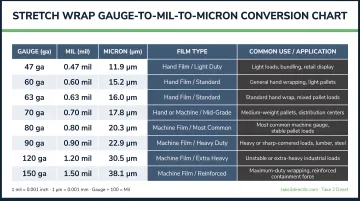
Micron conversions sourced from IPG technical data sheets and Veritiv product specifications.
True Gauge vs. Equivalent Gauge
This distinction is one of the most common sources of purchasing confusion.
True gauge film measures precisely at its labeled thickness on a micrometer. An 80-gauge true film physically measures 0.80 mil — no adjustment needed.
Equivalent (hybrid) gauge film is physically thinner but engineered with a metallocene-enhanced resin formulation that delivers comparable containment force at lower measured thickness. A 47-gauge equivalent film, for example, replicates the holding strength of an 80-gauge true film while using less material.
Western Plastics' HYBRiD80 illustrates this in practice: a multi-layer cast film at 47 gauge / 12 microns using metallocene additives, engineered to perform at 80-gauge holding strength. The trade-off is lower elongation capacity, making equivalent films better suited to smooth, boxed loads than to sharp-edged or irregular ones.
When comparing suppliers, always confirm whether a quoted gauge is true or equivalent, and whether specs are listed in gauge, mil, or micron — getting this wrong is the fastest way to end up with film that doesn't fit your application.
Gauge Ranges and Their Load Capacity
Commercially available pallet stretch wrap runs from 37 gauge at the lightest end up to 150 gauge for heavy-duty machine applications. The load capacities below are guide-level figures from packaging industry sources — not certified engineering limits — but they give you a practical starting point for selection.
Light-Duty Gauges: 37 to 60
| Gauge | Load Guidance | Notes |
|---|---|---|
| 37 | Up to ~800 lbs | Pre-stretched 80-gauge film; not a thin true-gauge film |
| 47 | Up to ~1,800 lbs | Hybrid/equivalent film; performs at ~60–80 gauge strength |
| 60 | Up to ~1,800 lbs | True gauge; good stretch for hand and machine application |
37-gauge film is often misunderstood. It's a pre-stretched version of 80-gauge film — already elongated before winding — which reduces application effort and extends coverage per roll, but limits it to lighter, uniform loads without sharp edges.
Standard-Duty Gauges: 63 to 80
- 63 gauge (16.0 microns per IPG spec data) — Better puncture and tear resistance than 60 gauge; right for loads with sharper corners or edges, up to approximately 2,200 lbs
- 80 gauge — The baseline for industrial pallet wrapping; handles approximately 2,200–2,400 lbs across hand wrapping, machine wrapping, and banding. If you're starting from scratch, this is where most operations begin.
Heavy-Duty Gauges: 90 to 150
- 90 gauge — Starting point for heavy loads (2,400–2,600 lbs); high tension tolerance and strong memory
- 100 gauge — Common for steel drums, structural products, and irregular loads up to approximately 2,800–3,000 lbs
- 115 gauge — Handles loads exceeding 3,000 lbs; reduced tear frequency on demanding loads
- 150 gauge — Heaviest commercially available cast machine film; requires automatic or semi-automatic stretch wrapper; used for very heavy and irregularly shaped loads
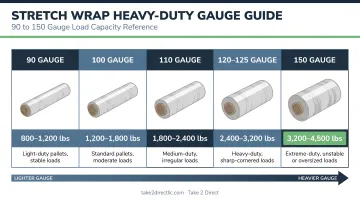
Heavy-duty gauges above 90 are almost exclusively machine-applied. Hand-wrapping these films is physically impractical and defeats the purpose of the higher tension capacity. Once you have a sense of where your loads fall on this range, the next step is matching gauge to your specific application conditions.
Film Types and How They Affect Gauge Performance
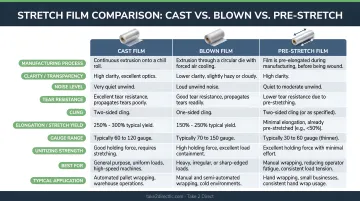
Two rolls with the same gauge number can deliver very different results depending on how they were made. Film type is the variable that most operations overlook when spec'ing stretch wrap. Three film types dominate the market — and each performs differently at the same gauge rating.
Cast Stretch Film
Cast film is made by melting resin and extruding it over cooled rollers. The result is a clear, glossy, uniform film that unwinds quietly and applies easily.
Key characteristics:
- Predictable, consistent stretch behavior
- Excellent clarity (good for barcode scanning through the film)
- Quieter to unwind than blown film
- Most common choice for light to medium-duty standard applications
Blown Stretch Film
Blown film is made by forcing melted resin through a circular die and inflating it into a tube with air pressure. The process produces a tougher, more opaque film.
Key characteristics:
- Higher puncture and tear resistance than equivalent cast gauges
- Better load memory — maintains tension after application
- Preferable for irregular shapes, sharp edges, and heavy loads
- Noisier to unwind; harder to apply by hand
When loads include sharp edges, irregular shapes, or heavy items, blown film typically outperforms cast at the same gauge.
Pre-Stretch Film
Pre-stretch film is wound onto the core after being elongated to approximately 90% of its maximum stretch capacity. This means:
- Less physical effort required during hand application
- More coverage per roll (fewer roll changes)
- Lower material consumption per pallet
- Best suited to lighter, uniform loads — the film's remaining stretch capacity after pre-stretching is limited
Knowing which film type you're buying matters as much as the gauge number — spec'ing a 80-gauge cast film and an 80-gauge blown film will give you meaningfully different performance on the same pallet.
How to Choose the Right Stretch Wrap Gauge
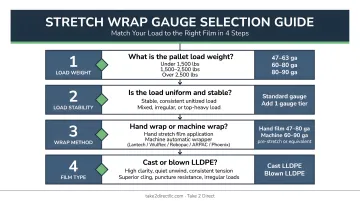
Gauge selection starts with two variables: load weight and load surface character.
Decision Hierarchy
- Start with load weight — use the gauge ranges above to identify the right tier (light, standard, or heavy duty)
- Adjust for load surface — sharp corners, mixed shapes, or protruding edges push you toward the higher end of the range or toward blown film
- Consider transit distance and handling — longer transit or multiple transfer points warrant a step up in gauge or a switch to higher-memory film
- Factor in application method — hand vs. machine significantly affects which film type makes sense
Hand vs. Machine Application
Hand film (12–18 inch widths) depends on the operator for consistent stretch. Cast films with predictable elongation behavior work best here — they tolerate variation in operator technique without losing load integrity.
Machine film (typically 20 or 30 inch widths) is applied by a stretch wrapper controlling pre-stretch at 150–300%. That mechanical consistency opens the door to thinner films: pre-stretch and high-performance equivalent-gauge options that cut per-pallet material cost without sacrificing hold.
An IPG case study illustrates the potential: switching to a 45-gauge ultra-high-performance machine film increased measured load retention while cutting annual film consumption by 51–102 rolls per machine and reducing costs by 14–22% per location. The customer rolled the change out across 10 facilities.
Realizing that kind of savings depends on having consistent access to the right gauge. Take 2 Direct carries stretch wrap across the full gauge range — hand film, machine film, extended core, and bundling formats — with same-day shipping available across major U.S. markets including Chicago, Dallas, Los Angeles, Atlanta, and Denver. For operations that can't afford long lead times or excess inventory, that availability is a practical advantage.
What Happens When You Use the Wrong Gauge
Under-Gauging
Film that's too thin for the load will hit its stretch limit before achieving adequate containment force. The practical consequences:
- Film tears during application, especially on corners and edges
- Load instability during transport — product shifts or falls
- Operators reduce wrap tension after breaks to stop the tearing, compounding the containment problem
Lantech identifies film breaks as the number-one stretch-wrapping problem, occurring roughly 3–7 times per roll on automatic high-speed wrappers on average. When operators respond by backing off tension, they're solving the symptom while making the underlying load stability problem worse.
Over-Gauging
Heavier film doesn't improve load security proportionally to its cost premium. Using 150-gauge film on a 1,200-lb uniform box load is a common example of gauge creep — teams default to the heaviest available film rather than matching gauge to the actual load profile.
The consequences go beyond wasted material:
- Higher material cost per pallet with no load security benefit
- Excessive compression force on crushable products (beverages, cereal boxes, etc.)
- More weight added to the load
- Fewer rolls per shipment, increasing order frequency and storage space required
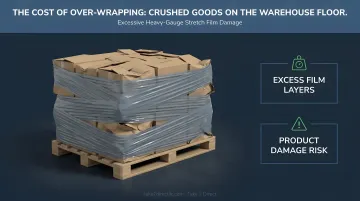
Operations that haven't revisited their film spec in years frequently find they're running heavier gauge than required across their entire pallet volume. It's rarely intentional — it just never gets questioned.
Common Misconceptions About Stretch Wrap Thickness
"Higher Gauge Always Means Better Film"
Thicker is only better when the load actually requires the strength. For lighter or uniform loads, a premium-grade thinner film with advanced resin often outperforms a heavier commodity film — at lower cost per pallet. A 63-gauge high-performance film can outperform a 100-gauge bargain film on the metrics that matter.
"Equivalent Gauge Film Is Weaker Than True Gauge"
This one gets buyers into trouble. A 47-gauge equivalent film isn't a budget 47-gauge film — it's engineered to replicate the containment force of a true 80-gauge film using less material. Buyers who assume equivalent = inferior end up over-purchasing true gauge film for applications where the equivalent option would work fine and cost less.
One real limitation applies: equivalent films aren't the right choice for loads with sharp edges, where puncture resistance depends on physical thickness.
"More Wraps Can Compensate for an Under-Weight Film"
Adding revolutions with the wrong film doesn't replicate the containment force of the correct gauge. Containment force depends on both the number of revolutions and wrap tension — if the film can't sustain adequate tension without tearing, more passes don't solve the problem. They add material cost and application time while leaving the puncture vulnerability in place.
Frequently Asked Questions
How thick is pallet wrap?
Standard pallet stretch film ranges from approximately 37 gauge (0.37 mil / ~9.4 microns) at the lightest end to 150 gauge (1.50 mil / ~38 microns) for heavy-duty machine applications. The most commonly used thickness for general pallet wrapping is 80 gauge (0.80 mil / ~20.3 microns).
Which is thicker, 60 or 80 gauge?
80 gauge is thicker. Gauge numbers scale directly with physical thickness — 80 gauge (0.80 mil / ~20.3 microns) is one-third thicker than 60 gauge (0.60 mil / ~15.2 microns) and is rated for heavier loads and more demanding wrapping conditions.
How thick is 120 gauge plastic wrap?
120 gauge equals 1.20 mil or approximately 30.5 microns. It's a heavy-duty gauge used primarily in machine applications for demanding pallet loads, sitting above the standard 80 gauge but below the 150-gauge maximum for cast machine films.
What is the most common stretch wrap gauge?
80 gauge is the industry reference standard and the most widely used thickness across general pallet wrapping. Most operations treat it as the baseline, stepping up to 100–120 gauge for heavier loads or down to 60 gauge for lighter, uniform cases.
What is the difference between true gauge and equivalent gauge?
True gauge film physically measures at its stated thickness on a micrometer. Equivalent (hybrid) gauge film is physically thinner but uses a denser resin formulation engineered to deliver comparable holding strength. It's cost-effective for standard box loads but not recommended where puncture resistance from sharp edges matters.
Is thicker stretch wrap always better?
No. Thicker film only adds value when load weight, product type, or transit conditions actually require the additional strength. Over-specifying gauge increases material costs, can compress lighter products, and adds weight without proportional gains in load security.