The two primary types — cast and blown — aren't interchangeable. They're manufactured differently, perform differently under real shipping conditions, and serve different operational needs. Picking the wrong one doesn't cause immediate, obvious failures. It just quietly eats into packaging costs, increases re-wrap time, or leaves loads more vulnerable in transit than they need to be.
This article breaks down exactly how cast and blown stretch wrap differ, where each one performs best, and how to match the right film to your operation.
Key Takeaways
- Cast stretch wrap is clear, glossy, quiet on unwind, and cost-efficient — the go-to for machine wrapping and standard pallet loads.
- Blown stretch wrap is tougher, hazier, and more expensive — built for heavy, sharp-edged, or irregularly shaped loads.
- Cast film stretches further per roll — up to 300–350% stretch — cutting cost per pallet on high-volume runs.
- For cold storage, rough transit, or loads that shift, blown film's superior holding power justifies the higher price.
Cast vs. Blown Stretch Wrap: Quick Comparison
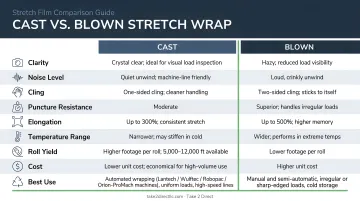
| Attribute | Cast Stretch Wrap | Blown Stretch Wrap |
|---|---|---|
| Clarity | High transparency, glossy finish | Hazy, dull appearance |
| Puncture Resistance | Moderate — can tear on sharp edges | Excellent — handles rough, irregular loads |
| Load Retention | Good for lighter, uniform loads | Superior holding power |
| Film Yield (Stretch) | Up to 300–350% stretch | Lower stretch yield; more film per pallet |
| Unwind Noise | Quiet | Loud, tacky unwind |
| Cost | Lower — faster production process | Higher — slower, more intensive manufacturing |
What Is Cast Stretch Wrap?
Cast stretch wrap is made through a cast extrusion process: molten resin is fed through a flat, linear die into a thin sheet, then rapidly cooled by chilled rollers. That fast, controlled cooling (called quenching) creates a film with uniform thickness and high optical clarity.
According to Lantech, cast film accounts for roughly 70–80% of all stretch film manufactured today, which speaks to its dominance in standard warehouse and distribution applications.
Performance Strengths
Three properties make cast film the default choice for most operations:
- Glossy, transparent finish enables barcode scanning and visual product checks without cutting the wrap — useful in high-throughput receiving and shipping environments
- Quiet unwind reduces noise in facilities wrapping dozens or hundreds of pallets daily
- Uniform thickness feeds reliably through automated wrapping equipment without film breaks or jams
Cost Advantage
Cast extrusion lines run fast — AMUT documents winding speeds of 800–1,000 meters per minute for cast stretch film lines. That production speed translates directly into lower cost per roll. Specific product lines from manufacturers like Inteplast and Efekt document pre-stretch capabilities of 300%+ and up to 350%, meaning more pallets wrapped per roll and lower film consumption per load.
A Note on Cling
Cling properties vary by product. Some cast films offer two-sided cling (useful for self-adhering during wrapping), while others use one-sided cling formulations specifically designed to prevent stacked pallets from bonding together in storage. Ask your supplier whether the film is one- or two-sided before ordering for stacked pallet storage.
Use Cases for Cast Stretch Wrap
Cast film is the dominant choice for semi-automatic and automatic pallet wrappers because its consistent stretch ratio and quiet unwind are well-matched to high-speed automated systems.
It excels in:
- Consumer packaged goods and retail distribution
- Food and beverage shipments
- Any application where label visibility or barcode scanning matters
- High-volume machine wrapping where cost per pallet is closely tracked
It's less suited for sharp-cornered loads, very heavy product, or shipments exposed to extreme temperatures.
Take 2 Direct carries machine grade, hand, extended core, bundling, and colored cast stretch film, with same-day shipping available across Atlanta, Charlotte, Chicago, Dallas, Denver, LA, and other markets.
What Is Blown Stretch Wrap?
Blown stretch wrap uses a fundamentally different manufacturing process. Molten resin is pushed through a circular die and inflated with compressed air into a tall, thin bubble — sometimes more than 10 feet high. Instead of chilled rollers, the bubble cools slowly using ambient air.
That slower cooling changes the film's molecular structure. The molecules align in two directions (biaxially), creating a criss-crossed pattern that gives blown film its signature toughness.
Performance Strengths
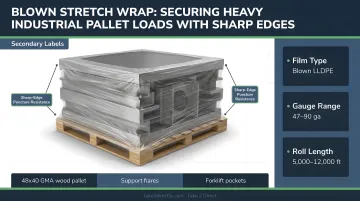
- Puncture resistance — resists tearing against sharp corners, metal edges, lumber, and irregular surfaces where cast film would fail (tested under ASTM D5748-95)
- Load retention — the film maintains strong holding force through transit, keeping loads tight even when stacked weight or rough handling puts pressure on them.
- Environmental resilience — the molecular structure holds up better against UV exposure, temperature fluctuations, and moisture, making blown film more reliable for cold chain and outdoor staging.
As Packaging World notes, cold-chain stretch wrap is produced as blown film specifically because of its superior performance over cast film in low-temperature conditions.
Trade-Offs Worth Knowing
Blown film comes with real drawbacks that affect day-to-day operations:
- Haze — the cloudy appearance makes barcode scanning and label reading harder without cutting the wrap
- Noise — the tacky surface creates audible noise when unwinding, which adds up in busy facilities
- Higher cost — slower production speeds mean higher cost per roll
- Lower film yield — more film is consumed per pallet compared to cast, which affects cost-per-load calculations
Use Cases for Blown Stretch Wrap
Blown film is the right choice for hand-wrapping applications and any load where puncture resistance isn't negotiable. Lantech identifies it as the preferred choice for heavy products including pulp, paper, and timber — that same logic applies to any load with sharp edges, dense weight, or irregular geometry.
A case documented by Packaging Impressions illustrates the stakes: a building materials manufacturer saw sharp-edged bricks puncturing stretch wrap during pallet wrapping, causing repeated load failures. Switching to a higher puncture-resistant film resolved the problem. That's precisely where blown film earns its place.
Industries where blown film dominates:
- Industrial manufacturing (metal components, auto parts, hardware)
- Building and construction materials
- Cold storage and refrigerated distribution
- Long-haul freight where load shifting is a known risk
- Outdoor staging and cross-dock environments
Cast vs. Blown Stretch Wrap: Which One Is Right for Your Operation?
Most facilities don't need to choose one and stick with it. Many warehouses run cast film through their automated lines for standard pallet loads, then keep blown film on hand for heavy or irregular loads that need extra holding power. That split approach is often the most cost-effective strategy.
Decision Framework
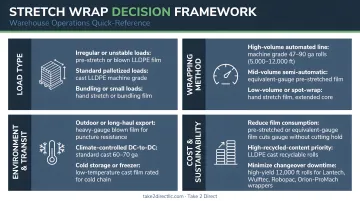
Evaluate four variables before committing:
- Load weight and shape — uniform, lighter loads favor cast; heavy, irregular, or sharp-edged loads favor blown
- Application method — machine wrapping favors cast; for hand wrapping, both work, though blown's natural tack gives it a practical edge in manual applications
- Operating environment — climate-controlled indoor facilities suit cast; cold storage, outdoor staging, and temperature-variable conditions favor blown
- Cost-per-load priority — cast wins on film yield and roll cost; blown justifies its higher price when preventing load damage and re-wraps is the priority
Clear-Cut Recommendations
Choose cast stretch wrap when:
- You're running a semi-automatic or automatic pallet wrapper
- Loads are uniform, lighter, and don't have sharp edges
- Barcode scanning or label visibility matters
- You're optimizing for cost per pallet at high volume
Choose blown stretch wrap when:
- Loads are heavy, sharp-edged, or irregularly shaped
- You're shipping through cold storage or harsh transit conditions
- Load shifting during freight is a documented risk
- Your team is hand-wrapping and needs a film that grips firmly
Lantech's own guidance aligns with this framework — noting that insufficient film tension (a risk with the wrong film type) can lead to product shifting or damage during transport.
Work With a Supplier Who Carries Both
Once you know which film fits your operation, sourcing from a single supplier who carries both keeps things simple. Take 2 Direct stocks cast and blown stretch wrap in machine grade, hand film, extended core, and bundling formats. Same-day shipping is available from locations across Atlanta, Charlotte, Chicago, Dallas, Denver, Los Angeles, and more. Pricing runs up to 30% below national catalog suppliers — a meaningful difference for facilities moving through multiple cases per week.
If you're not sure which film makes sense for your loads, the Take 2 Direct team brings over 100 years of combined supply chain experience and can work through the specifics with you.
Conclusion
Cast and blown stretch wrap both secure pallet loads — they just do it differently, for different types of loads. Cast film wins on clarity, cost-efficiency, and machine compatibility. Blown film wins on durability, puncture resistance, and cold-chain performance.
The right call depends on what you're wrapping, how you're wrapping it, and where it's going. Get that alignment right, and you reduce film waste, cut packaging costs, and keep more loads arriving intact. Wrong film for the job means either paying for protection you don't need or skimping on loads that can't afford the risk.
If you're sourcing stretch wrap for a warehouse, distribution center, or 3PL operation, Take 2 Direct carries both cast and blown options — available for same-day shipping across all major US markets.
Frequently Asked Questions
What is blown pallet wrap?
Blown pallet wrap is stretch film made through a blown extrusion process, where molten resin is pushed through a circular die, inflated into a bubble, and cooled slowly by ambient air. The result is a hazy, tough film with high puncture resistance and strong load retention — suited for heavy or irregularly shaped loads.
Which is better: cast or blown pallet wrap?
Neither is universally better. Cast is the right choice for standard loads, machine wrapping, and cost-sensitive applications where clarity matters. Blown is better when loads are heavy, sharp-edged, or irregularly shaped, or when transit conditions are rough enough to risk load shifting or film failure.
How can you tell cast and blown pallet wrap apart visually?
Cast stretch wrap is clear and glossy — labels and barcodes are readable right through it. Blown wrap appears hazy or cloudy with a matte surface. They also sound different: cast unwinds quietly, while blown produces a louder, tackier pull.
Is blown stretch wrap more expensive than cast?
Yes. Blown stretch wrap costs more per roll due to its slower manufacturing process and lower film yield. For heavy-duty or high-risk loads, the added cost is typically offset by fewer load failures and less re-wrapping.
Can cast stretch wrap be used with automated pallet wrappers?
Cast stretch wrap is the preferred film for automated and semi-automatic pallet wrappers. Its consistent thickness and quiet unwind make it well-suited to high-speed machine applications. Blown film can run on machines, but it's more commonly applied by hand.
Is cast or blown stretch wrap better for cold storage?
Blown stretch wrap is generally the better choice for cold storage. Its molecular structure maintains cling, strength, and load retention at low temperatures. Cast film can become more brittle in cold environments, making blown the safer option for refrigerated or frozen distribution operations.