Introduction
Warehouse managers face a familiar set of pressures: product damage claims piling up, packaging budgets under scrutiny, and outbound shipments that need to move faster without arriving in worse condition. Stretch wrap film sits at the intersection of all three.
Most operations treat pallet wrap as a line-item commodity — something you reorder when supplies run low and otherwise ignore. That's a costly habit. The right film, applied correctly, directly reduces damaged shipments, cuts labor time, deters theft, and keeps workers safer.
Skip it or choose wrong, and you'll pay more in damage claims, rework, and delays than the film ever would have cost.
This article breaks down 7 concrete benefits of stretch wrap film — and what each one means for your shipping costs, labor efficiency, and loss prevention.
Key Takeaways
- Stretch wrap film (LLDPE-based) unitizes palletized loads, binding individual items into a single stable unit for storage and transit
- Covers 7 core benefits: load stability, protection, labor savings, theft deterrence, safety, versatility, and sustainability
- Applies to both hand-wrapping and machine-wrapping — scalable for any operation size
- Poor or skipped wrapping creates damage claims, injuries, and theft losses that cost far more than the film
- Matching film type and gauge to your load profile is what delivers the full value
What Is Stretch Wrap Film?
Stretch wrap film — also called stretch film or pallet wrap — is a highly elastic plastic film made primarily from linear low-density polyethylene (LLDPE). It clings to itself when wrapped tightly around a load, creating a secure, unitized package without adhesives or fasteners.
ASTM D4649 covers its use for "unitizing, reinforcing, and palletizing" across indoor environments: warehouses, truck trailers, rail boxcars, and transfer terminals. Its purpose is functional: hold a pallet load together under the real forces of forklift handling, transit vibrations, and storage stacking.
Available formats include:
- Hand stretch film (manual application, lower-volume operations)
- Machine grade stretch film (automated wrappers, consistent tension, higher throughput)
- Extended core, bundling, and colored stretch film for odd-shaped loads, bundle containment, and SKU color-coding
7 Benefits of Stretch Wrap Film in Your Warehouse
Each benefit below ties to outcomes warehouse managers actually track — damage rates, labor hours, safety incidents, packaging costs.
Benefit 1: Load Stability That Prevents Damaged Shipments
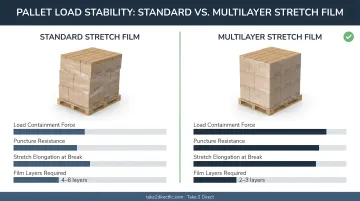
Stretch wrap applies consistent holding force across an entire pallet load. As the film is applied under tension, individual boxes, bags, or items become a single unitized load — one that resists shifting, tilting, and collapse during handling and transit.
This matters because the forces involved in freight movement are significant. Research on palletized cargo cites cargo-securing requirements of 0.8 g forward acceleration and 0.5 g sideways/backward, with EUMOS testing standards requiring that load shift not exceed 5% of pallet height and inclination not exceed 10%. The same study found that a 23-micron standard film using 448 g per pallet load failed a 0.5 g test, while a 20-micron multilayer film using only 225 g passed — demonstrating that film selection, not just film quantity, determines performance.
KPIs directly impacted:
- Product damage rate per shipment
- Freight claim frequency
- Inventory shrinkage from handling
- Customer return rate
When this benefit matters most: High-volume shipping operations, facilities handling fragile or irregularly shaped products, and warehouses where pallets are moved multiple times before outbound shipping.
Every damaged shipment generates replacement costs, return processing, and potential customer chargebacks. Getting load stability right upstream prevents those costs from ever appearing on a report.
Benefit 2: Protection from Dust, Moisture, and Environmental Contaminants
A properly wrapped pallet acts as a physical barrier between your product and everything in its path — dust accumulation, moisture exposure, minor spills, and airborne debris during storage, dock staging, and transit.
For industries where cleanliness is non-negotiable, this matters beyond basic product protection. FDA sanitary transportation guidance requires that food transportation operations protect food against physical, chemical, and microbiological contamination — a wrapped pallet supports that objective during the handling and storage phases.
Industries where this benefit is most operational:
- Food and beverage distribution
- Pharmaceuticals
- Electronics
- Retail (packaging condition affects shelf presentation)
KPIs directly impacted:
- Product rejection rates
- Hygiene compliance incidents
- Storage-related inventory loss
Stretch wrap adds a practical contamination barrier at the pallet level — keeping loads clean through storage and transit without adding secondary packaging steps or cost.
Benefit 3: Cost Reduction and Labor Efficiency
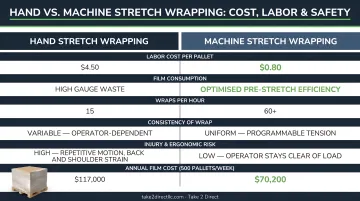
Stretch wrap reduces packaging costs in two ways simultaneously: it uses minimal material per load compared to alternatives like strapping, boxing, or over-packaging, and it speeds up the wrapping process whether done by hand or machine.
The material efficiency gains are real and measurable. The palletized cargo study referenced earlier found a 20-micron multilayer film used 225 g per pallet — roughly half the material of the 448 g standard film — while actually performing better under dynamic testing. Better film selection doesn't just reduce material waste; it can improve load performance at the same time.
Machine-grade film extends these gains further. Automated stretch wrappers apply pre-programmed tension consistently across every pallet, eliminating variation and reducing per-unit film consumption through pre-stretch capability.
OSHA's warehousing guidance also identifies manual stretch wrapping as a potential ergonomic hazard. A mechanical wrapper eliminates that risk while cutting labor time per pallet — two wins from one equipment decision.
KPIs directly impacted:
- Packaging cost per pallet
- Labor hours per pallet
- Film waste percentage
- Total cost of goods shipped
When this benefit matters most: High-volume operations wrapping dozens to hundreds of pallets per day, lean-staffed facilities, and distribution centers where packaging speed affects outbound throughput.
Suppliers like Take 2 Direct stock machine grade stretch film alongside hand stretch options, with pricing up to 30% lower than national catalog suppliers — a meaningful difference when film costs are multiplied across thousands of pallets annually.
Benefit 4: Theft Deterrence and Shipment Integrity
A tightly stretch-wrapped pallet creates a visible tamper barrier. Anyone accessing the load must visibly cut or tear through the film — making tampering immediately obvious during receiving or inspection.
This is not a trivial concern. CargoNet reported 3,625 cargo theft events across the U.S. and Canada in 2024, up 27% year over year, with an average estimated value per theft of $202,364. Opaque or colored stretch wrap adds a second layer of deterrence: it conceals product contents from opportunistic theft and makes any film removal or re-wrapping more immediately detectable.
Take 2 Direct's colored stretch film inventory supports this application directly — color-coded wrapping also helps operations visually classify loads by handling priority or shipment type.
When this benefit matters most: High-value goods shipments, cross-docking operations, loads that transfer through multiple hands before final delivery.
At a few cents per pallet, stretch wrap delivers a deterrence layer that requires no program overhead, no training, and no additional equipment — just film applied consistently.
Benefit 5: Improved Worker Safety in the Warehouse
Unsecured or improperly stacked pallets are a consistent source of warehouse injuries. OSHA 1910.176(b) is direct on this: materials stored in tiers must be stacked, blocked, interlocked, and limited in height so they are stable and secure against sliding or collapse. A properly wrapped pallet supports that standard at the unit load level.
A NIOSH FACE report on a forklift incident involving a full pallet of soft drink cans notes explicitly that employees should understand the risk of injury from an unstable pallet that can lead to falling material or a pallet row collapse — the kind of failure that properly tensioned stretch wrap is designed to prevent.
When this benefit matters most:
- Busy receiving and shipping docks
- Warehouses with high pallet stacking requirements
- Facilities subject to OSHA compliance reviews for load safety
Stretch wrap creates a stable, contained unit that is safer to move, stack, and store. For facilities where forklifts and pedestrians share floor space, that stability is a meaningful safety control.
Benefit 6: Versatility Across Different Load Types and Industries
Stretch wrap film works across an exceptionally wide range of load types — uniform cases, irregular industrial shapes, bundled items, light consumer goods — because the film conforms to the load rather than requiring the load to conform to the packaging.
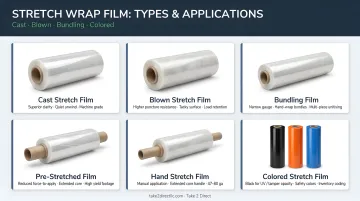
Different film formulations extend this versatility further:
| Film Type | Best For |
|---|---|
| Cast film | Uniform, lighter loads; high clarity for label/barcode visibility |
| Blown film | Sharp-edged, heavy, or irregular loads; higher puncture resistance |
| Bundling film | Smaller items or non-palletized bundles |
| Extended core film | Ergonomic hand application; high-throughput hand-wrap operations |
| Colored film | Security, load classification, tamper visibility |
IPG's technical data for hand stretch film spans 65 to 120 gauge, with 80-gauge film reporting 6,200 psi ultimate tensile strength in the machine direction — giving a sense of the range of holding force available across the product line.
When this benefit matters most: Warehouses handling diverse SKUs or mixed product types, operations serving multiple industry verticals, or facilities that frequently adjust pallet configurations.
Benefit 7: A More Sustainable Packaging Choice
Modern LLDPE-based stretch wrap film is recyclable — but not through standard curbside programs. Per How2Recycle guidelines, plastic film must be collected separately, kept clean and dry, and sent through dedicated film recycling streams or store drop-off programs.
For warehouses already separating post-industrial plastic film, this is operationally straightforward. Take 2 Direct's post-industrial recycling operations include buying and selling plastic film — giving customers a ready-made recovery pathway rather than a program to build from scratch.
The sustainability gains extend beyond end-of-life recycling:
- Downgauging: Selecting a thinner but higher-performance film can cut material use per pallet by 30–50% without compromising load integrity
- Recycled-content options: Manufacturers including Berry (30% PCR content in Bontite Sustane) and IPG (60% total recycled content in StretchFLEX PCR) now offer verified recycled-content stretch films
- Weight reduction: Stretch film is significantly lighter than alternative protective packaging, which reduces transport weight and fuel consumption per shipment
Credible sustainability gains require combining right-gauging, load testing, clean film collection, and verified recycled-content products — each step compounds the reduction in material and transport impact.
What Happens When Stretch Wrap Film Is Skipped or Misused
Skipping stretch wrap — or applying it incorrectly — produces predictable, compounding problems:
- Undertensioned film lets individual items shift in transit — the load behaves like it was never wrapped at all
- Wrong film type gives false security — cast film on a sharp-edged industrial load tears, triggering downstream rework and delays
- Partial coverage exposes corners and top surfaces, the two points on any pallet most vulnerable to impact and moisture
- No wrap means forklift acceleration, dock transitions, and transit vibration all act on the load with nothing to absorb or constrain them
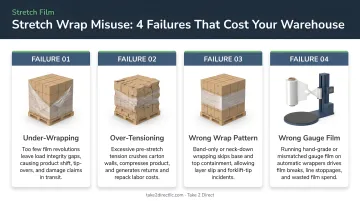
Each of these failures drives a real cost: more freight claims, more rework, and slower outbound operations. None of them are difficult to prevent — but all of them are expensive to fix after the fact.
How to Get the Most Value from Stretch Wrap Film
Getting full value from stretch wrap means making the right call on film spec, application tension, and supplier — in that order.
Match Film to the Load
Match gauge and formulation to load weight, shape, and transit distance. Lighter, uniform loads can run on thinner gauges. Heavy, irregular, or sharp-edged loads need blown film with higher puncture resistance.
ASTM D4649 provides the standards framework for selection. EUMOS 40509 and ISTA 3E offer performance-testing context for validating that a given film and wrap pattern holds under real transit conditions.
Control Application Tension
Undertensioned film doesn't unitize loads. Overtensioning can compress or damage products. Machine wrapping removes this variability by applying pre-programmed tension on every pallet — a meaningful quality control step in high-volume operations.
Source Consistently from One Supplier
Take 2 Direct stocks hand stretch film, machine grade stretch film, extended core, bundling, and colored stretch film — all available for same-day shipping across 10 U.S. markets including Chicago, Dallas, Los Angeles, Atlanta, and New York.
With pricing up to 30% lower than national catalog suppliers and a team carrying over 100 years of combined supply chain experience, Take 2 Direct can match the right film spec to your load type and keep your supply chain running from a single source.
Conclusion
Stretch wrap film's value in the warehouse extends well beyond keeping boxes on a pallet. It directly influences damage rates, labor efficiency, worker safety, theft deterrence, and packaging costs — and those advantages add up quickly when the right film is applied consistently across every pallet that leaves your facility.
Stretch wrap only delivers on these benefits when it's treated as a deliberate operational choice. That means selecting the right formulation for your load type, applying it at the correct tension, and tracking the KPIs it directly affects. Three areas to prioritize:
- Film selection: match gauge and formulation to your load weight and transit conditions
- Application consistency: standardize tension and wrap patterns across manual and machine application
- Performance tracking: measure damage claims, film usage per pallet, and labor time before and after changes
Take 2 Direct stocks a full range of stretch wrap film — from standard hand rolls to high-performance machine film — available for same-day shipping across all 10 of our US service markets.
Frequently Asked Questions
Frequently Asked Questions
What is the purpose of stretch wrap film in a warehouse?
Stretch wrap film unitizes and secures palletized loads during storage and transit, preventing product movement and protecting against dust, moisture, and environmental contaminants. It reduces the risk of shipment damage, theft, and worker injury from unstable pallet loads.
Which is better for warehouse use, cast or blown stretch wrap film?
Cast film is clearer, quieter to unwind, and more economical — a good fit for uniform, lighter loads. Blown film is tougher and more puncture-resistant, making it the better choice for heavy, irregularly shaped, or sharp-edged loads. The right answer depends on your load profile, not a default preference.
Which industries commonly use stretch wrap film?
Stretch wrap film is used across warehousing, 3PL, food and beverage distribution, pharmaceuticals, retail, manufacturing, e-commerce, electronics, and automotive — essentially any industry that palletizes and ships goods at volume.
What is the difference between hand stretch film and machine stretch film?
Hand stretch film is applied manually and suited to lower-volume operations. Machine stretch film is designed for automated stretch wrappers that apply consistent tension at higher speeds, typically using less material per pallet through pre-stretch capability and cutting labor costs at scale.
How do I choose the right stretch wrap film thickness for my loads?
Match gauge to load weight and shape: lighter, uniform loads can use thinner gauges (65–70), while heavy, irregular, or sharp-edged loads need thicker or blown-film options. A supplier with product expertise will get you to the right spec faster than floor-level trial and error.
Is stretch wrap film recyclable?
Most LLDPE-based stretch wrap film is recyclable, but it cannot go into standard single-stream recycling bins. It must be collected separately, kept clean and dry, and sent to a stretch film recycling facility. Many suppliers and post-industrial recycling programs — including those offered by Take 2 Direct — handle collection and diversion.