
That blind spot has real cost consequences. Without knowing your pallets-per-roll baseline, you can't calculate cost per pallet, identify waste, or make an informed decision between hand and machine wrapping.
The answer isn't a single number. It depends on roll length, film width, stretch rate, pallet dimensions, and how consistently your team wraps. This guide breaks down the estimates, the formula, and the variables that change everything.
Key Takeaways
- Hand rolls (18"×1,500 ft) cover approximately 13–15 pallets at typical stretch rates
- Machine rolls (20"×5,000 ft) cover approximately 95–115 pallets at 250% pre-stretch
- Roll length and stretch rate are the two biggest drivers — machine pre-stretch (150–300%) multiplies usable footage far beyond what hand wrapping achieves
- Use the three-step formula below to calculate exact yield for your specific pallet dimensions and roll specs
How Many Pallets Does a Roll of Stretch Wrap Cover?
There's no single fixed answer. The estimates below use a standard 48"×40" GMA pallet footprint loaded to 60" tall, with four bottom revolutions, two top revolutions, and 50% film overlap — a common distributor calculation baseline, not an association-certified standard.
Estimated Pallets Per Roll by Common Roll Size
| Roll Format | Stretch Rate | Estimated Pallets |
|---|---|---|
| 18"×1,500 ft hand roll | ~70% | ~13 pallets |
| 18"×1,000 ft hand roll | ~70% | ~8–9 pallets |
| 15"×1,500 ft hand roll | ~70% | ~11–12 pallets |
| 20"×5,000 ft machine roll | 250% | ~95 pallets |
| 20"×6,000 ft machine roll | 250% | ~114 pallets |
| 30"×5,000 ft machine roll | 250% | ~114 pallets |
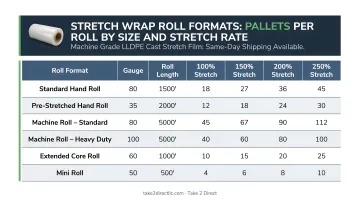
Treat these as planning benchmarks. Real-world yield varies based on how consistently your team applies tension and how your loads are configured.
What causes actual results to differ:
- Inconsistent manual tension (the most common issue)
- Taller or wider loads consuming more footage per revolution
- Loose wrapping habits that leave film underutilized
- Narrower rolls (15" vs. 18") requiring more vertical passes per pallet
Hand rolls are commonly sold in 1,500 ft lengths, with 1,000 ft available for lower-volume use. Machine rolls are typically 5,000 ft, with longer formats available for thinner-gauge film. Once you know your roll length and typical wrapping pattern, you can calculate cost per pallet and compare roll formats side by side.
Key Factors That Affect Pallets Per Roll
Key Factors That Affect Pallets Per Roll
Four variables determine whether a roll wraps 8 pallets or 95 — and understanding each one is what makes stretch wrap budgeting predictable.
Roll Length and Film Width
Longer rolls mean more footage — straightforward enough. A 6,000 ft machine roll produces more pallets per order than a 5,000 ft roll at the same stretch rate.
Width matters too. A 15" roll requires more vertical passes to cover the same pallet height as an 18" roll, consuming extra footage per pallet. For tall loads, that difference adds up across a full day of wrapping.
Stretch Rate and Pre-Stretch
This is where the real yield gap opens up. According to Lantech, machine pre-stretch commonly ranges from 150% to 300%, meaning each linear foot off the roll becomes 2.5 to 4 feet of film on the load.
Robopac confirms that a 5,000 ft roll at 250% pre-stretch yields 17,500 ft of usable film. Hand wrapping, by contrast, produces no substantial pre-stretch and inconsistent film use — the yield is lower and harder to predict.
Machine wrapping covers far more pallets per roll than hand wrapping — even when the machine roll is shorter.
Pallet Dimensions
Taller and wider pallets need more footage per revolution. A pallet loaded to 72" tall consumes more film per pass than one loaded to 60". The pallet's diagonal — determined by its length and width — also affects how much film each revolution requires.
Non-standard pallet sizes will skew any standard estimate, so measure before assuming a published range applies to your operation.
Revolutions, Overlap, and Load Type
The four-bottom, two-top, 50% overlap pattern is a starting baseline. Heavier or unstable loads may need extra passes — but every additional revolution reduces total pallets per roll.
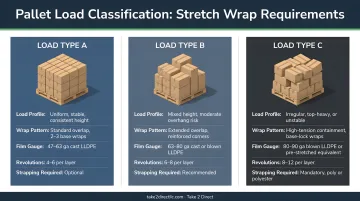
Paragon Films defines three load types that affect wrap requirements:
- Type A — Uniform shape, closely matches pallet size, minimal puncture points, fewest revolutions needed
- Type B — Less uniform, irregular stacking, several puncture points; common in smaller manufacturing and distribution environments
- Type C — Highly variable sizes and shapes, sharp points common, typical at distribution centers fulfilling retail orders
Type A loads wrap cleanly with fewer revolutions. Type B and C loads require more passes, heavier gauge film, and higher tension — all of which reduce how many pallets you get from a single roll.
How to Calculate Pallets Per Roll: Step-by-Step Formula
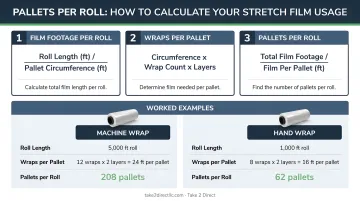
Once you have your pallet dimensions and roll specs, this takes three steps.
Step 1 — Determine Film Needed Per Pallet
Film usage depends on your load geometry and wrap pattern. To get your footage-per-pallet number, account for:
- Pallet length, width, and height
- Number of base and top revolutions
- 50% overlap as film travels up and down the load
For a standard 48"×40"×60" pallet with a baseline wrapping pattern, footage per pallet typically falls between 150–200 ft of unstretched hand film.
Step 2 — Calculate Stretched Footage Per Roll
Formula: (Stretch Rate + 1) × Roll Length = Stretched Footage Per Roll
Two worked examples:
- Machine roll at 250% stretch: (2.5 + 1) × 5,000 = 17,500 ft
- Hand roll at 70% stretch: (0.7 + 1) × 1,500 = 2,550 ft
That difference — 17,500 ft vs. 2,550 ft — explains almost the entire yield gap between machine and hand wrapping.
Step 3 — Divide Stretched Footage by Film Per Pallet
Formula: Stretched Footage Per Roll ÷ Film Needed Per Pallet = Pallets Per Roll
Example using ~184 ft per pallet on a standard load:
- 17,500 ÷ 184 = ~95 pallets from one 5,000 ft machine roll at 250% stretch
- 2,550 ÷ 184 = ~14 pallets from one 1,500 ft hand roll at 70% stretch
One important caveat: hand wrapping rarely achieves its theoretical stretch rate consistently. Real-world hand wrap yield typically runs 10–20% below the formula's projection — so build in a buffer when estimating how many rolls you'll need per shift or shipment.
Hand Wrap vs. Machine Wrap: Pallets Per Roll Compared
A hand roll covers roughly 8–15 pallets depending on roll size and technique. A machine roll covers 95–115+ pallets. The difference comes from pre-stretch consistency, not just roll length — and the operational gap is equally significant.
Robopac data shows manual wrapping takes 5–10 minutes per pallet versus 1–2 minutes with a machine, and can consume up to 50% more film than calibrated machine wrapping.
For a facility wrapping 50 pallets daily, that's roughly 350 minutes of manual labor versus 100 minutes by machine — per day.
When hand wrap is the better choice:
- Low-volume operations (occasional pallets, not daily production)
- Locations without a stretch wrap machine
- Spot-wrapping situations where only a few pallets need securing between machine runs
For high-volume distribution and 3PL operations, machine wrap delivers lower film cost per pallet once volume justifies the equipment. Take 2 Direct carries both hand stretch film and machine stretch film — so whether you're running a single dock door or a full distribution line, it's easy to match the right format to your volume.
Tips to Get More Pallets Per Roll
Small adjustments in technique and product selection add up across thousands of pallets.
Train workers to apply steady, even tension throughout the wrap cycle for hand wrapping; for machine wrapping, verify pre-stretch settings are calibrated and not drifting. Inconsistent stretch is the most common reason actual yield falls short of expected coverage.
Stick to the wrapping pattern appropriate for your load type — extra passes on stable, uniform loads waste footage without improving containment. A quick audit often reveals how many unnecessary revolutions are happening per shift.
Match gauge to load weight — too heavy wastes film, too light risks breaks and re-wrapping. As a general weight-based guide from Uline:
| Gauge | Load Weight |
|---|---|
| 60 gauge | Up to 1,600 lbs |
| 70 gauge | Up to 2,000 lbs |
| 80 gauge | Up to 2,500 lbs |
| 90 gauge | Up to 3,000 lbs |
| 120 gauge | Up to 4,000 lbs |
Common Mistakes That Reduce Roll Yield
Most roll yield problems trace back to three operator-level habits — and none of them require a purchasing change to fix.
Too many revolutions per pallet. Adding wraps beyond what a load actually needs is the single biggest source of wasted film. Most standard pallets don't require more than the baseline pattern, and a simple per-shift audit can quantify exactly how much footage is going to waste.
Inconsistent tension during wrapping. A roll that should stretch to 2,550 ft at 70% elongation might only reach 2,000 ft if operators apply uneven tension. That 550-foot shortfall means fewer pallets per roll and a higher cost per pallet, with no improvement in load security.
Mismatched roll format for the operation. A small operation running machine rolls it can't fully cycle through, or a high-volume warehouse relying on hand rolls and forfeiting machine pre-stretch yield — both scenarios inflate packaging costs without delivering better containment.
Frequently Asked Questions
How many feet of stretch wrap does one pallet require?
A standard 48"×40"×60" pallet typically requires approximately 150–200 ft of unstretched hand film using four bottom and two top revolutions with 50% overlap. Machine film, by comparison, covers the same pallet with roughly 50–70 ft off the roll thanks to its built-in pre-stretch.
What is the standard length of a hand stretch wrap roll?
Hand stretch wrap rolls are commonly sold in 1,500 ft lengths, with 1,000 ft rolls available for lower-volume use. Machine rolls are typically 5,000 ft, with longer formats available for thinner-gauge film.
How do I calculate pallets per roll?
Follow three steps:
- Calculate footage needed per pallet based on dimensions and wrapping pattern
- Calculate stretched footage using (Stretch Rate + 1) × Roll Length
- Divide stretched footage by footage per pallet
Does pallet size affect how many pallets I can wrap per roll?
Yes. Taller and wider pallets consume more footage per wrap cycle, directly reducing roll yield. A pallet loaded to 72" tall wraps out noticeably fewer pallets per roll compared to one loaded to 60".
How does stretch rate affect pallets per roll?
A higher stretch rate multiplies usable footage. At 250% machine pre-stretch, a 5,000 ft roll becomes 17,500 ft of effective coverage. At 70% hand stretch, a 1,500 ft roll becomes only 2,550 ft.
Is hand wrap or machine wrap cheaper per pallet?
Machine rolls cost more upfront, but the higher yield per roll (95+ pallets vs. ~13 for hand wrap) results in lower film cost per pallet at volume. For operations wrapping dozens of pallets daily, machine wrap is the more economical choice.