
Introduction
Ordering the wrong pallet size creates problems that compound fast. A pallet that's too wide gets rejected at the loading dock. One that's too narrow lets your load shift in transit. The wrong height throws off your racking clearances, and incompatible footprints mean your forklift can't engage at all.
These are real, costly mistakes that happen when operations teams rely on guesswork instead of verified specs.
This guide covers everything you need to make the right call: the North American standard pallet size, a complete sizing chart, industry-specific dimensions, physical specs, construction types, and a practical framework for choosing the right pallet for your operation.
TLDR: Key Pallet Size Facts at a Glance
- The North American standard is 48″ × 40″ (the GMA pallet), accounting for over 30% of all U.S. pallets in use
- Other common sizes — 42×42, 48×48, 40×40, 48×36 — serve specific industries like beverage, dairy, and chemical
- A standard 48×40 wood pallet stands 4.75–6.5 inches tall empty and holds up to 4,600 lbs at capacity
- Choosing the right size depends on your product footprint, load weight, carrier specs, and racking system
What Is the Standard Pallet Size?
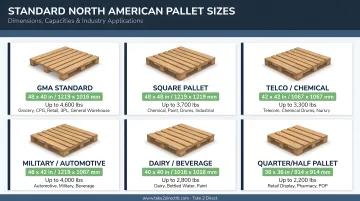
The standard pallet size in North America is 48 inches × 40 inches, established by the Grocery Manufacturers Association (GMA) to standardize product flow across grocery and retail supply chains.
The GMA rebranded as the Consumer Brands Association in 2020, but the name stuck — these are still called "GMA pallets" throughout the industry.
The Standard Pallet Size Chart
| Pallet Size (W × L) | Common Name / Industry | Notes |
|---|---|---|
| 48″ × 40″ | GMA / Grocery / General Freight | Most common U.S. size |
| 42″ × 42″ | Paint / Telecom / Square Pallet | Originally designed for military use |
| 48″ × 48″ | Chemical / Drum Pallet | Sized for 55-gallon drums |
| 48″ × 42″ | Beverage / Chemical | Listed common size |
| 40″ × 40″ | Dairy | Compact square for hygienic handling |
| 48″ × 36″ | Paper / Beverage / Shingles | Narrow profile for specific loads |
| 40″ × 48″ | Export / Grocery | Same footprint as 48×40, different orientation |
| 36″ × 36″ | Beverage | Smallest common pallet size |
Deck Board Construction (48×40)
Understanding the board layout helps when assessing load capacity and pallet condition. The 48×40 GMA pallet uses a specific board pattern:
- 7 top deck boards — two 5.5″ end boards plus five 3.5″ middle boards
- 5 bottom deck boards — two 5.5″ end boards plus three 3.5″ boards
- 3 stringers running lengthwise, approximately 1.38″ wide × 3.5″ high × 48″ long
- Deck board thickness ranges from 5/16″ to 1/2″ depending on the manufacturer
International Pallet Standards (Brief Reference)
North American sizes don't translate directly to international shipping. The main differences:
- European (EPAL Euro pallet): 800mm × 1200mm (~31.5″ × 47.2″), governed by EPAL product standards
- Asia/Japan (JIS): 1100mm × 1100mm
- ISO 6780:2003 covers intercontinental flat pallets for global trade
If you're shipping internationally, confirm pallet compatibility with your freight forwarder before placing an order — mismatched specs can cause delays at customs or loading docks.
Standard Pallet Sizes by Industry
Industry-specific sizes evolved for practical reasons: product footprints, truck configurations, and storage systems vary by sector. Using the right size for your industry avoids load overhang, poor stability, and carrier rejections.
Industry-to-Pallet Size Reference
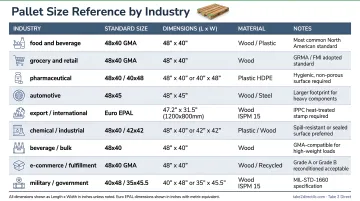
| Industry | Standard Pallet Size |
|---|---|
| Grocery / FMCG | 48″ × 40″ |
| Dairy | 40″ × 40″ |
| Beverage | 36″ × 36″ or 48″ × 36″ |
| Paint / Telecom | 42″ × 42″ |
| Chemical / Drums | 48″ × 48″ |
| Automotive | 48″ × 45″ |
| Beverage / Chemical | 48″ × 42″ |
| Paper / Shingles | 48″ × 36″ |
| Military / Cement | 40″ × 48″ |
| Retail Display | 48″ × 20″ |
Three Non-GMA Sizes Worth Knowing
42×42 — Used in paint and telecom distribution. Originally designed for U.S. military mortar transport, the square footprint balances cylindrical or irregularly shaped loads better than rectangular alternatives.
48×48 — Built to hold 55-gallon drums in chemical and oil applications. The extra width ensures drums sit within the pallet footprint rather than hanging over the edge.
40×40 — The compact square design accommodates dairy case dimensions and meets sanitation requirements. Plastic 40×40 dairy pallets often feature non-porous solid decks that can be sanitized easily.
The 48×45 Automotive Pallet
The automotive industry developed its own standard to handle the irregular geometry of auto parts. The 48×45 spec is documented by the Suppliers Partnership for the Environment and widely adopted by OEMs and their tiered suppliers. It enables standardized rack storage at assembly plants across the supply chain.
GMA Grade A vs. Grade B (For Recycled Pallets)
If you're sourcing recycled 48×40 pallets, you'll encounter these trade grades:
- Grade A (or #1): No stringer repairs, food-grade clean, 7 top / 5 bottom boards intact — suitable for food and pharmaceutical applications
- Grade B (or #2): May have stringer repairs or companion blocks, visible wear — lower cost, appropriate for general freight
Note: these are trade definitions, not formal NWPCA standards, and grading consistency varies by supplier. Take 2 Direct carries both new and recycled 48×40 pallets across 10 U.S. markets. Contact us directly for grade-specific availability.
Standard Pallet Weight, Height, and Load Capacity
The 48×40 GMA pallet is the most common format in US warehousing, but weight and capacity specs vary more than most buyers expect — especially between wood and plastic options.
Physical Specs for the 48×40 GMA Pallet
| Specification | Wood Pallet | Plastic Pallet |
|---|---|---|
| Height (empty) | 4.75″ – 6.5″ | Varies by model |
| Weight (empty) | 30 – 48 lbs | 13 – 42+ lbs (model-specific) |
| Static load capacity | Up to ~4,600 lbs | 3,500 – 30,000+ lbs (model-specific) |
Load Capacity: What the Ratings Actually Mean
Rated capacity assumes static, evenly distributed loads on a flat floor surface. Once conditions change, effective capacity drops:
- Dynamic loads (in transit with forklift movement) are often 40–50% lower than static ratings
- Racked storage further reduces capacity — a pallet rated at 4,600 lbs static may support only 1,800–4,500 lbs on rack beams depending on beam span
- Plastic pallets have a much wider range: economy models start around 3,500 lbs static, while heavy-duty variants from manufacturers like ORBIS and TranPak exceed 30,000 lbs floor-rated
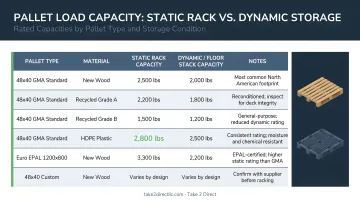
Always match the pallet's load rating to your actual support condition — floor storage, racking, and transit each require a different capacity threshold.
Pallet Types and Configurations
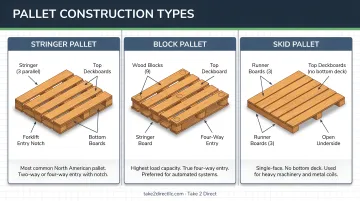
Three Primary Construction Types
1. Stringer Pallets The most common type in the U.S. Uses three 2×4 boards (stringers) running lengthwise between deck boards. Unnotched stringers allow two-way entry only; notched stringers enable four-way entry for forklifts.
2. Block Pallets Use cylindrical or square blocks at corners and center points. True four-way entry from all sides. More durable than stringer pallets and preferred for high-cycle closed-loop applications.
3. Skids Single top deck with no bottom deck. The lightest and simplest option, used for heavy static loads where forklift entry from below isn't required.
Deck Configurations That Affect Performance
- Solid deck — No gaps between boards; ideal for bags, small parts, or anything that would fall through standard gaps
- Double face — Has both top and bottom decks; non-reversible versions (like the GMA pallet) have a designated load-bearing face; reversible versions can be flipped
- Double wing — Deck boards extend beyond the stringers on both sides, useful for oversized loads and easier shrink-wrap application
Two-Way vs. Four-Way Entry
The entry configuration affects how efficiently your operation moves product through docks and racking systems:
- Four-way entry — Forklift or pallet jack access from all four sides; reduces repositioning time at every touch point in high-throughput facilities
- Two-way entry — Access from opposite sides only; can create bottlenecks in tight dock or racking configurations
How to Choose the Right Pallet Size for Your Operation
Key Decision Factors
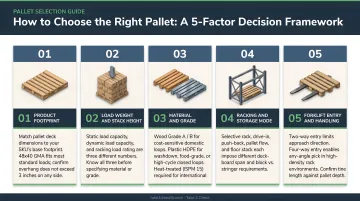
Work through these before placing any pallet order:
- Product footprint — Load should sit fully within the pallet surface with no more than 1″ of overhang per side
- Load weight — Match the static and dynamic load ratings to your actual weights, not the pallet's maximum rating
- Carrier requirements — Confirm your carrier accepts the pallet dimensions; some freight networks have specific requirements
- Racking compatibility — Verify that pallet length and width align with your beam spans and rack depth
- Forklift entry — Confirm whether your equipment needs two-way or four-way access
How Many 48×40 Pallets Fit in Common Trucks and Containers?
This is one of the most common planning questions for warehouse and logistics operations:
| Equipment | Floor-Loaded (Straight) | Notes |
|---|---|---|
| 16-ft box truck | ~8 pallets | Based on ~16′ L × 7′7″ W interior |
| 20-ft box truck | ~10 pallets | Based on ~20′ L × 8.5′ W interior |
| 26-ft box truck | ~12 pallets | Based on ~26′ L × 102″ W interior |
| 53-ft dry van | 26 straight / 28 pinwheeled / 30 turned | Per ATS; orientation significantly affects count |
| 20-ft ISO container | ~8–9 pallets (single layer) | Calculated from 19′4″ L × 7′9″ W interior |
| 40-ft ISO container | ~18–19 pallets (single layer) | Calculated from 12,032mm L × 2,352mm W interior |
Two 48″ pallet widths require 96″, which fits within the typical 98–100″ internal width of U.S. dry vans. That's exactly why the 48×40 aligns so cleanly with standard North American trailer specs.
Finding the Right Supplier
Once you've nailed down the right size, availability becomes the next bottleneck. Take 2 Direct supplies new, recycled, heat-treated, and plastic pallets across 10 major U.S. markets (Atlanta, Charlotte, Chicago, Dallas, Denver, Inland Empire, Los Angeles, Minneapolis, NYC, and Savannah) with same-day shipping on in-stock sizes and up to 30% savings compared to national catalog suppliers.
Frequently Asked Questions
What are the standard pallet sizes?
The North American standard is 48″ × 40″ (the GMA pallet). Other widely used sizes include 42×42 (paint/telecom), 48×48 (chemical/drums), 40×40 (dairy), and 48×36 (paper/beverage). Each is standard within its respective industry.
How many 48×40 pallets fit in a box truck?
A 16-ft box truck holds approximately 8 pallets floor-loaded; a 20-ft holds about 10; a 26-ft holds about 12. Actual counts depend on interior dimensions, load height, and whether pallets are straight-loaded or turned.
How tall is a standard pallet?
A standard 48×40 GMA wood pallet stands approximately 4.75 to 6.5 inches tall when empty. Total shipment height depends on what's stacked on top plus any stretch wrap or tier sheets.
How much does a standard pallet weigh?
Standard wood 48×40 pallets weigh approximately 30–48 lbs empty. Plastic pallets vary widely by model, with lighter export-style pallets around 13 lbs and heavier rackable models exceeding 40 lbs.
What is a GMA pallet?
A GMA pallet is the 48″ × 40″ standard established by the Grocery Manufacturers Association. The GMA rebranded as the Consumer Brands Association in January 2020, but "GMA pallet" remains the industry's default term for this size.
What is the difference between a 2-way and 4-way pallet?
A 2-way pallet accepts forklift or pallet jack entry from two opposite sides only. 4-way pallets open on all four sides, which improves handling speed and flexibility — especially in dock environments where positioning can't always be controlled.