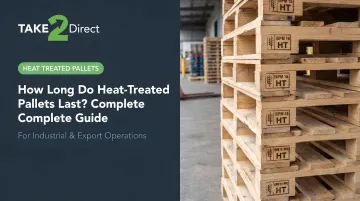
The short answer: a well-maintained heat-treated pallet typically lasts 3 to 5 years under regular commercial use. With light use and proper storage, some pallets push toward 10 years. But that range is a guideline, not a guarantee — and several variables can compress it significantly.
There's also a critical distinction worth understanding early: the physical pallet and its ISPM 15 certification age differently. One degrades from use and environment. The other doesn't expire at all — unless you introduce new wood.
This guide breaks down both questions: how long the pallet lasts, and how long the certification holds.
Key Takeaways
- Heat-treated wooden pallets last 3–5 years on average, up to 10 years with light use and proper care
- The ISPM 15 certification does not expire — it lasts for the pallet's lifetime unless new untreated wood is added
- Wood species, storage conditions, load weight, and usage frequency each play a direct role in how long a pallet holds up
- Regular inspection and minor repairs extend service life — often by years
- Consistent sourcing from a vetted supplier is the most reliable way to avoid compliance gaps
What Are Heat-Treated Pallets?
Heat-treated (HT) pallets are wooden pallets processed through controlled heating to eliminate pests, larvae, and pathogens in the wood. Under ISPM 15 requirements, the wood's core must reach a minimum of 56°C (133°F) and hold that temperature for at least 30 consecutive minutes.
The ISPM 15 Mark
After treatment, pallets receive a permanent stamp that includes:
- The IPPC symbol
- A two-letter ISO country code
- The producer/treatment-provider code
- The treatment designation — "HT" for heat treatment
This mark is globally recognized and required for wood packaging material entering most major import markets, including the U.S., EU, Canada, and Australia.
HT vs. Kiln-Dried: Not the Same Thing
Heat treatment under ISPM 15 is a phytosanitary process — its purpose is pest eradication, not moisture reduction. Kiln-drying (KD) is a separate designation focused on lowering moisture content in wood.
A pallet can be both HT and KD — stamped "KD HT" — and that combination offers the most protection for both compliance and physical durability. But a KD stamp alone is not proof of ISPM 15 compliance, and an HT stamp alone doesn't mean the wood will stay dry in poor storage conditions.
How Long Do Heat-Treated Pallets Last?
The 3–5 year benchmark reflects regular commercial use: consistent warehouse throughput, standard loads, and reasonable handling. Most wooden pallets — HT or otherwise — fall somewhere in that window.
No authoritative source separates HT pallets from non-HT pallets on lifespan specifically. USDA Forest Service research and Virginia Tech's unit load studies both frame pallet durability in terms of design, species, damage accumulation, and handling — not treatment status. Heat treatment addresses phytosanitary risk, not physical longevity.
New vs. Reconditioned HT Pallets
| Pallet Type | Expected Lifespan | Key Consideration |
|---|---|---|
| New HT pallet | 3–5 years (regular use), up to 10 years (light use) | Full cycle count remaining |
| Recycled/reconditioned HT pallet | Variable — depends on prior wear | Fewer usable cycles; inspect before export use |
Take 2 Direct stocks both new and recycled heat-treated pallets in standard 48x40 and custom sizes — useful when different applications call for different quality tiers.
When to Inspect
Even within the average lifespan window, don't wait for visible failure. Regular visual checks should catch:
- Cracked or broken deck boards
- Damaged or split stringers
- Mold growth or moisture staining
- A faded, damaged, or illegible ISPM 15 stamp
A pallet that passes inspection at year two may be marginal at year three, depending on what it's been carrying and where it's been stored.
Key Factors That Determine Heat-Treated Pallet Lifespan
Wood Species
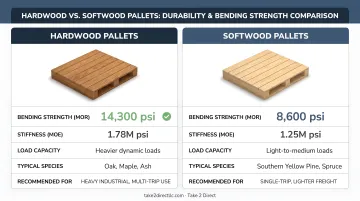
Species is one of the most underestimated durability variables. USDA Forest Service testing of recovered pallet parts found that mixed hardwood parts were 41% stronger and 40% stiffer than mixed softwood parts. Used oak deckboards averaged 9,606 psi in bending strength; softwood deckboards averaged 6,662 psi under the same conditions.
What that means practically:
- Hardwood pallets (oak, maple) resist wear, deflection, and structural damage longer under equivalent loads
- Softwood pallets (pine, spruce) are more common and cost less, but wear faster in high-cycle operations
- The same ISPM 15 stamp can appear on both — species doesn't affect compliance, but it directly affects how many cycles you'll get
When sourcing, ask about species. The difference compounds across thousands of cycles.
Storage Conditions
Wood is hygroscopic — it absorbs and releases moisture based on ambient conditions. HT pallets can reabsorb moisture after treatment, which promotes mold, fungal decay, and dimensional warping over time.
Best practices for storage:
- Store pallets flat and off the ground
- Keep them in a dry, covered environment away from rain and direct sunlight
- Avoid storing near untreated wood or in pest-prone areas
- Don't stack pallets against exterior walls where temperature swings cause moisture cycling
A pallet that survives years of warehouse cycles can still deteriorate quickly from a single season of poor storage conditions.
Load Capacity and Usage Frequency
Overloading causes cumulative structural stress — and it happens more often than operations teams realize. A standard recycled Grade A 48x40 GMA pallet carries a 6,000 lb static capacity, 2,200 lb dynamic capacity, and 2,000 lb racking capacity (per manufacturer spec). Those numbers are not universal and vary by pallet design and support conditions.
Virginia Tech research confirms that pallet damage worsens gradually from prolonged use rather than sudden failure — stringer notches and bottom lead deckboards show the highest damage occurrence.
Usage frequency matters as much as load weight. A pallet running daily warehouse cycles will reach end-of-life far sooner than one used for occasional storage, regardless of treatment quality.
Handling Practices
Load stress and storage conditions set the ceiling — handling determines how fast you get there. Mechanical damage accumulates from:
- Improper forklift entry angles that split stringers and crack bottom boards
- Dragging or dropping pallets, which accelerates joint failure and deck fractures
- Uneven stacking that warps boards, especially in fluctuating temperatures
Operator training and consistent handling standards extend pallet life more reliably than upgrading to a higher-grade pallet at sourcing.
How Long Does the Heat Treatment Certification Last?
This is where most buyers have the wrong mental model. The ISPM 15 certification doesn't have a renewal date. Per ISPM 15 guidance, a pallet that has been treated, marked, and not repaired, remanufactured, or otherwise altered does not require re-treatment or re-marking throughout its entire service life.
The certification is permanent — unless you change the wood.
The Repair Rule
ISPM 15 distinguishes between repairs and remanufacturing:
- Repairs (up to roughly one-third of components replaced): Replacement wood must be treated or processed material. Added components should be individually marked.
- Remanufacturing (more than one-third of components replaced): All old marks must be permanently obliterated, and the pallet must be re-treated and re-stamped entirely.
- Adding untreated solid wood for any repair: The pallet becomes noncompliant for export use until it is re-treated and re-stamped by a certified facility.
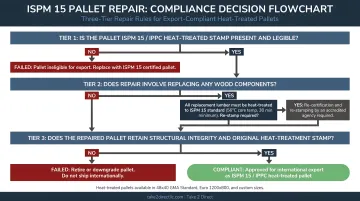
Non-compliance carries serious consequences. CBP guidelines note potential penalties of up to $5,000 for a first violation and $10,000 for subsequent violations for non-compliant wood packaging material.
Re-Contamination Risk
One thing the certification does not protect against: re-exposure. ISPM 15 explicitly states that its measures are not intended to provide ongoing protection from contaminating pests.
A pallet stored near untreated wood, in a pest-prone environment, or at a high-risk port can be re-exposed to organisms. The stamp remains valid, but the compliance and biosecurity risk is real.
The straightforward fix is supplier vetting. Confirm your supplier is ISPM 15 certified, request documentation up front, and verify that any replacement wood used in repairs carries its own treatment mark.
How to Extend the Life of Your Heat-Treated Pallets
Three things make the biggest difference:
1. Store them correctly from the start. Off the ground, stacked flat, in a dry covered area. Reintroduced moisture is the leading cause of premature degradation — and it's entirely preventable.
2. Inspect regularly and fix small problems before they become large ones. A cracked deck board that gets addressed early doesn't turn into a failed stringer later. If you're maintaining export compliance, remember: replacement boards must use certified HT wood, or the pallet needs re-treatment.
3. Start with quality pallets. This is the highest-leverage decision. A pallet that enters your operation in good condition — with intact ISPM 15 markings and appropriate species for your load — will deliver more usable cycles than a marginal pallet that looks acceptable on day one.
Take 2 Direct stocks heat-treated pallets in new and recycled conditions across all 10 U.S. service markets — Atlanta, Charlotte, Chicago, Dallas, Denver, Inland Empire, Los Angeles, Minneapolis, NYC, and Savannah — with same-day shipping availability. For operations that can't afford gaps in compliant pallet supply, a local source with consistent HT inventory keeps your supply chain moving without scrambling for last-minute alternatives.
Frequently Asked Questions
Are heat-treated pallets better than regular pallets?
For export shipments, yes — ISPM 15 compliance is mandatory, and HT pallets meet that requirement. For domestic-only use, the choice depends on your application. Some buyers specify HT for hygiene-sensitive operations even domestically, but it isn't a federal requirement for domestic U.S. shipping.
Does the heat treatment wear off over time?
No. The heat treatment is a permanent process — the wood has been altered at a molecular level to eliminate pests. The ISPM 15 certification doesn't have an expiration date. What degrades over time is the physical pallet, not the treatment status.
Can heat-treated pallets be repaired and still keep their ISPM 15 certification?
Minor repairs that don't introduce new wood — tightening fasteners, for example — leave certification intact. Any replacement of wood components requires treated material, and if more than roughly one-third of the pallet is replaced, it must be fully re-treated and re-stamped.
How do I know when a heat-treated pallet needs to be replaced?
Look for broken or missing deck boards, cracked stringers, visible mold, or a damaged/illegible ISPM 15 stamp. Any of those conditions warrants pulling the pallet from active service.
Are heat-treated pallets required for domestic shipping in the U.S.?
No. ISPM 15 compliance is required for international shipments, not domestic U.S. movement. However, food-grade or pharmaceutical operations may require HT pallets domestically — that's a buyer specification issue, not a federal mandate.