The problem isn't that corrugated boxes are fragile. It's that their lifespan varies dramatically based on construction, environment, and how they're used — and most operations don't know the difference until they're filing a damage claim.
This guide covers how long corrugated cardboard actually lasts across different use cases, the specific factors that shorten or extend that lifespan, and the operational practices that help you get maximum value from every box.
Key Takeaways
- Corrugated boxes last anywhere from a single shipment to several years, depending on construction and storage conditions
- Store boxes at 40–100°F and 30–70% RH to preserve structural integrity over time
- Moisture is the single biggest lifespan killer — compression strength drops 7% for every 1% increase in moisture content
- Pallet overhang and interlocked stacking can destroy 30–55% of a box's compression strength
- Right-sizing wall construction — single, double, or triple-wall — to your actual load weight prevents premature failure and extends usable life
What Is Corrugated Cardboard and Why It's Built the Way It Is
Corrugated cardboard is structurally distinct from regular paperboard: it consists of two flat linerboards with a wavy, fluted medium glued between them. That fluted core acts like an arch, distributing compression loads and absorbing shock in ways flat paperboard simply can't.
Wall Construction Types
The Fibre Box Association defines the three main configurations:
- Single-wall (double face): one fluted medium between two linerboards — the standard for most general shipping applications, rated at 32 ECT
- Double-wall: three linerboards with two fluted mediums — rated at 48 ECT, suited for heavier loads up to 100 lbs
- Triple-wall: four linerboards with three fluted mediums — used for industrial freight and heavy-duty palletized loads
Flute Size and What It Affects
Flute profile determines cushioning and compression characteristics:
- A-flute (~33 flutes/ft): maximum cushioning, highest vertical compression strength
- C-flute (~38 flutes/ft): all-purpose profile, the most commonly used in standard shipping boxes
- B-flute (~47 flutes/ft): developed for self-supporting canned goods, good crush resistance in a thinner profile
- E/F-flute (90–125 flutes/ft): thin, smooth surface for retail-style packaging and small folding cartons
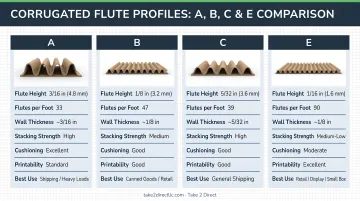
A B-flute single-wall box and an A-flute double-wall box may look identical from the outside but perform completely differently under load. When evaluating corrugated cardboard longevity, construction grade is a more reliable predictor than box size alone.
How Long Does Corrugated Cardboard Last?
Corrugated cardboard can last anywhere from one use to several years — the difference comes down to how boxes are used, stored, and handled throughout their life cycle.
Lifespan for Active Shipping Use
Boxes used for repeated shipping degrade with each transit cycle. Compression loads, vibration, and humidity exposure gradually weaken the fluted structure. According to FedEx's packaging guidelines, reused boxes are only acceptable when they show no damage and remain fully intact — a standard that eliminates many boxes after just one or two trips.
Practical realities by construction type:
- Single-wall boxes carrying heavy or dense contents typically last 1–2 trips before structural degradation becomes a risk
- Double or triple-wall boxes can handle multiple trips with proper handling, though each cycle adds cumulative stress to flutes and seams
- Inspect every box before reuse regardless of wall count — UPS guidelines explicitly advise against reusing boxes when in doubt
Lifespan for Long-Term Storage
The FBA/PMMI B155-TR2.3 storage standard states that unused corrugated containers stored under recommended conditions should perform their intended containment and stacking functions for at least 12 months from manufacture. Boxes intended for automated machinery should be used within 3–6 months.
Those conditions are specific: 40–100°F and 30–70% relative humidity. Outside that range, degradation accelerates.
Lifespan for Reuse and Secondary Purposes
Once a box completes its first shipment, it can still serve internal transfers, light storage, or secondary packaging — adding months of useful life. The catch: flute damage isn't always visible. A box that handled a load fine on its first trip can fail under the same weight on its second, so inspection before reuse isn't optional.
Key Factors That Determine How Long Corrugated Cardboard Lasts
Two boxes with identical dimensions can have completely different lifespans. Here's why.
Material Quality and Wall Construction
The grade of linerboard used — primarily kraft (virgin fiber) versus testliner (recycled fiber) — affects moisture resistance and long-term compression strength. Virgin fiber liners offer better tear resistance and perform more consistently in chilled or humid applications.
ECT ratings quantify this directly:
| Construction | ECT Rating | Max Gross Weight |
|---|---|---|
| Single-wall | 32 ECT | 65 lbs |
| Double-wall | 48 ECT | 100 lbs |
ECT (Edge Crush Test) measures the force required to crush board standing on edge — the directly relevant measure for stacking and palletized loads. Using a 32 ECT box for a 90-lb load exceeds the rated capacity and leads to box failure under normal stacking conditions.
Humidity and Moisture Exposure
Moisture is the primary threat to corrugated longevity. Research from Clemson University's compression strength study found:
- Compression strength decreases 7% for every 1% increase in moisture content
- Effects begin above 30% RH, where paper fibers start losing stiffness
- At 85%+ RH, stacking strength can fall to roughly 50% of rated potential
Beyond compression loss, high humidity above 70% can soften or dissolve the starch adhesive bonding the layers — causing delamination. Low humidity below 30% creates the opposite problem: boards and adhesives become brittle.
Temperature Extremes
The FBA/PMMI standard recommends storage between 40–100°F. Outside that range:
- Heat dries out fibers, making boards brittle and more susceptible to cracking under flex
- Cold near loading docks or unheated warehouses reduces moisture content and increases fragility; AICC recommends processing and storing corrugated in areas above 55°F
Stacking and Palletization Practices
How boxes are stacked on a pallet directly affects how much of their rated strength they actually deliver. Research from Cal Poly quantified the losses:
- Pallet overhang can reduce compression strength by up to 32%, with losses ranging 23–49% depending on magnitude and direction
- Interlocked stacking patterns can reduce top-to-bottom compression strength by 45–55% due to vertical misalignment
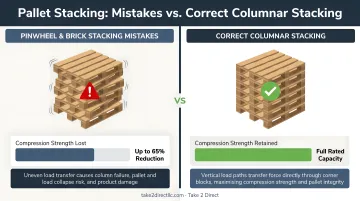
Columnar stacking — where box corners align vertically — keeps compression force properly distributed through the box structure. Interlocking breaks that path.
How Frequently the Box Is Handled
Each pick-up, transit cycle, and resealing event accumulates micro-stress at flutes and seams. Industry guidance generally limits corrugated boxes to 3–5 trip cycles before structural integrity becomes unreliable — a threshold that high-frequency distribution environments can hit within days. Matching box grade to actual usage intensity, not just product weight, is what keeps that limit from becoming a liability.
Warning Signs That Your Corrugated Boxes Need to Be Replaced
Using a structurally compromised box risks product damage, failed shipments, and stacking hazards. In a warehouse or fulfillment environment, one collapsed stack can damage an entire pallet of product — far more expensive than swapping out a degraded box.
Replace any box that shows these signs:
- Soft or mushy walls — moisture has infiltrated the fluted structure
- Visible delamination — linerboard layers separating from the medium
- Crushed or collapsed flutes — compression capacity is gone, regardless of how the outside looks
- Torn or split corners and seams — these are the primary load-bearing points
- Box won't hold square — the structure has lost rigidity and can no longer stack reliably
A FIFO (first in, first out) rotation policy for box inventory prevents another common failure point. Use older stock before newer stock so boxes don't degrade in storage before they're ever deployed.
Best Practices to Extend the Life of Corrugated Cardboard
Control Your Storage Environment
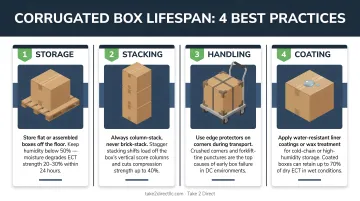
Store boxes in a climate-controlled space within the 40–100°F and 30–70% RH range. Keep them:
- Off the floor on pallets or dunnage to prevent moisture wicking
- Away from overhead pipes and exterior walls
- Clear of loading dock doors that repeatedly introduce humid or cold air into your storage area
Stack and Palletize Correctly
- Use columnar stacking — not interlocked patterns — to keep compression force aligned through box corners
- Eliminate pallet overhang entirely; even small overhang can cost you 23–49% of compression strength
- Stabilize palletized loads with stretch wrap rather than relying on stacking pattern for stability
Train Staff on Proper Handling
Physical handling habits directly affect usable box life. Specific behaviors to reinforce:
- No throwing or dropping bundled boxes
- No sitting or standing on boxes (yes, it happens)
- Always observe printed weight limits — exceeding them by even 20% accelerates seam failure
Apply Protective Coatings When Needed
For humid or cold-chain environments, water-resistant coatings extend box life measurably. The Fibre Box Association (FBA) reports that recyclable wax alternatives now account for a larger share of the market than traditional wax treatments. Manufacturers like Mondi offer moisture-resistant kraftliner as a direct wax replacement for wet applications.
Reinforce high-stress points — corners and seams — with additional tape or edge protectors when boxes will face heavy loads or rough handling.
Source the Right Box for the Job
The most effective lifespan strategy is matching construction grade to actual use requirements from the start. A single-wall box pressed into service for heavy freight will underperform and need constant replacement — costing more than the right box would have.
Businesses that consolidate corrugated sourcing through a supplier with broad selection avoid the common trap of using whatever's on hand rather than what's right for the application. Take 2 Direct stocks corrugated boxes across multiple product lines — including heavy-duty, multi-depth, telescoping, and bulk cargo configurations — with same-day shipping availability across 10 major US markets, and pricing up to 30% below national catalog suppliers.
Frequently Asked Questions
How long do corrugated cardboard boxes last?
Lifespan ranges from a single shipment to several years, depending on construction and storage. Boxes in proper storage conditions (40–100°F, 30–70% RH) should remain usable for at least 12 months from manufacture per FBA standards. Construction quality and environment are the decisive variables.
Can bacteria grow on cardboard?
Yes. The CDC lists paper and cardboard among materials where mold can grow when moisture is present. Damp or food-residue-contaminated boxes should never be reused in food or hygiene environments, as mold on packaging can cause cross-contamination.
How many times can corrugated cardboard be recycled?
FEFCO cites studies showing cardboard fibers can withstand more than 25 recycling cycles with no significant quality loss. The American Forest & Paper Association puts the practical figure at 5–7 uses per fiber before degradation becomes a factor.
Does humidity affect how long corrugated boxes last?
Significantly. Clemson research found compression strength drops 7% per 1% increase in moisture content, and stacking strength can fall to roughly 50% of rated capacity above 85% RH. The FBA/PMMI standard warns that humidity above 70% can soften or dissolve the adhesive bonding the layers together.
What's the difference between single-wall and double-wall corrugated in terms of durability?
Double-wall corrugated adds an extra fluted layer, raising the ECT rating from 32 to 48 and the maximum rated gross weight from 65 lbs to 100 lbs. It handles repeated shipping trips, heavier loads, and harsher storage conditions substantially better than single-wall construction.
How do you know when a corrugated box needs to be replaced?
Look for soft or mushy walls, visible delamination, crushed flutes, torn seams or corners, and boxes that no longer hold their shape when assembled. Any of these indicate the box can no longer reliably protect its contents.