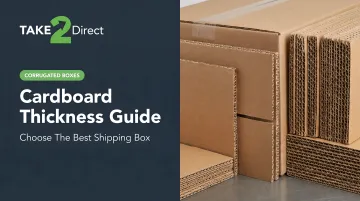
This guide covers how corrugated cardboard thickness actually works — the flute types, wall constructions, and ECT ratings that determine whether a box survives transit — and how to match those specs to your specific shipping requirements.
Key Takeaways
- Corrugated cardboard thickness is defined by flute type (A, B, C, E) and wall construction (single, double, triple) — not just how the box feels.
- ECT (Edge Crush Test) ratings measure how much load a box edge can bear before buckling — the primary strength metric for shipping.
- C flute (~3/16") handles most shipping needs; B flute (~1/8") suits lighter loads where print quality matters.
- For heavy or multi-layer shipments, double or triple-wall construction provides the stacking strength standard single-wall boxes can't match.
- Wrong box specs lead to damaged goods, carrier non-compliance, or higher shipping costs from unnecessary box weight.
- Match specs to product weight, fragility, transit distance, stacking needs, and budget.
What Is Cardboard Thickness and Why Does It Matter?
Not all cardboard is the same. The thin stock used in retail folding cartons is single-layer paperboard — fine for a cereal box, useless for a 25 lb shipment. Corrugated cardboard is something else entirely.
As the Fibre Box Association defines it, corrugated board consists of three components:
- Outer linerboard — the smooth exterior face
- Inner linerboard — the smooth interior face
- Fluted medium — a wavy paper layer sandwiched between the two liners
The flutes form arches when bonded to the linerboards, creating rigid columns that resist vertical compression. That structural geometry is what makes corrugated boxes capable of shipping everything from apples to washing machines.
Thickness matters for three practical reasons:
- Compression resistance — thicker walls with taller flutes handle more stacking weight
- Puncture resistance — denser flute construction resists impacts during handling
- Shipping weight — heavier board adds to package weight, which affects carrier charges
Thicker is not automatically better. Overpaying for double-wall board on a lightweight shipment wastes money; underpaying with single-wall on a heavy pallet stack risks damage claims. The right spec depends on what you're shipping — and that starts with understanding flute types.
Corrugated Flute Types: A, B, C, and E Explained
Flute grades are named in the order they were developed, not by size. Each has a different thickness, flute density, and functional profile.
Here's how the four main single-wall flute grades compare:
| Flute | Thickness | Flutes/Foot | Best For |
|---|---|---|---|
| A | ~1/4" (0.19–0.23") | ~33 | Fragile/breakable items, impact cushioning |
| B | ~1/8" (0.11–0.15") | ~47 | Die-cut boxes, printing, lighter shipments |
| C | ~3/16" (0.15–0.19") | ~38 | General shipping, e-commerce, distribution |
| E | ~1/16" (~1.5mm) | ~90 | Retail packaging, mailers, print-forward packaging |
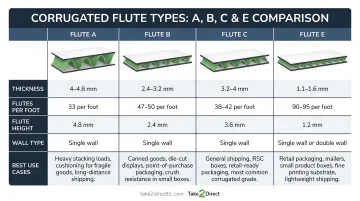
A Flute (~1/4" / 0.19–0.23")
About 33 flutes per foot. The tallest flute profile, offering the most cushioning and shock absorption. Best suited for fragile or breakable items that need impact protection. The tradeoff: it's bulkier and costs more per box than C or B flute, making it less common in standard e-commerce fulfillment.
B Flute (~1/8" / 0.11–0.15")
About 47 flutes per foot — denser than C flute, which gives it strong puncture and crush resistance. The tighter flute structure also creates a smoother surface. Choose B flute when print quality matters:
- Die-cut and display-style packaging
- Lighter-weight shipments with branded exteriors
- Retail-adjacent boxes where appearance is a factor
C Flute (~3/16" / 0.15–0.19")
About 38 flutes per foot. The Fibre Box Association calls C flute the all-purpose flute. It balances stacking strength, cushioning, and cost in a way that works for the widest range of applications — which is why it dominates regular slotted containers (RSCs) across e-commerce, distribution, and fulfillment.
E Flute (~1/16" / ~1.5mm)
About 90 flutes per foot. The thinnest shipping-appropriate option. E flute has an excellent print surface and a sleek, low-profile appearance — common in retail packaging and mailer-style boxes. It offers less cushioning than B or C and is more susceptible to crushing under significant load.
Double-Wall and Triple-Wall Construction
When a single wall isn't enough, double-wall boards combine two fluted mediums and three linerboards. BC flute (B and C layers combined) measures approximately 0.26–0.31" thick and is common for industrial or heavy-duty shipping. UPS Packaging Guidelines recommend double-wall construction for shipments in the 81–100 lb range and above.
How Shipping Box Strength Is Measured
Thickness alone doesn't tell you how strong a box is. Two boxes can have the same flute type and feel completely different under load. Strength ratings are what bridge that gap.
ECT (Edge Crush Test)
The ECT rating measures how many pounds per linear inch of load the edge of a corrugated board can withstand before buckling: the most direct measure of compression resistance during stacking and transit. A "32 ECT" rating means the board can handle 32 lbs per inch of edge compression.
This is what the number in a box spec refers to. "32C" means C-flute board with a 32 ECT rating. Here's how those ratings map to practical weight limits per UPS Packaging Guidelines:
| ECT Rating | Max Box Weight | Max Size (L+W+H) |
|---|---|---|
| 32 ECT | Up to 30 lbs | Under 75" |
| 44 ECT | 31–50 lbs | 75–85" |
| 55 ECT | 51–65 lbs | 85–96" |
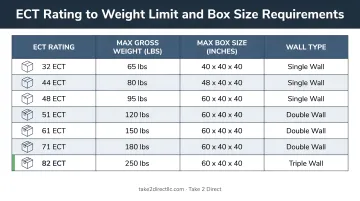
ECT dominates modern box specs, but a second test still appears on many carrier certificates and supplier documents.
Mullen (Burst) Test
The Mullen test measures the force required to rupture the face of the corrugated board using hydraulic pressure. It's a puncture resistance metric rather than a compression metric. Some carriers and box certificates still publish both values — UPS, for example, lists both Burst and ECT figures in its box strength table, so you may see both on a Box Maker's Certificate.
The Box Maker's Certificate (BMC)
Look at the bottom flap of most corrugated boxes and you'll find a small circular stamp. That's the BMC. It discloses the board's wall construction, ECT or burst rating, size limits, gross weight limit, and minimum combined weight of facings. Per UPS, the gross weight limit printed on the BMC should never be exceeded. Operations managers sourcing boxes at scale should check the BMC before committing to a box spec — it tells you exactly what the board is rated for and where its limits are.
How to Choose the Right Cardboard Thickness
The right spec connects three variables: what's inside the box, how it's getting there, and what the total cost needs to be. Here's how to think through each factor.
Product Weight and Fragility
Weight is the most direct input. Heavier products require higher ECT ratings — a 30 lb item needs at least a 32 ECT box; a 45 lb item needs 44 ECT. Fragile products add another layer: breakables benefit from the additional cushioning that taller flutes (A or C) provide over thinner options like E flute.
One practical note: carriers calculate shipping charges on the greater of actual weight or dimensional weight. The box's own weight contributes to actual weight, so over-specifying board for a light shipment can quietly increase outbound costs.
Shipping Distance and Handling
A box shipping two stops across town faces very different conditions than one moving through a multi-node UPS or FedEx network. Long-haul parcel shipments go through sorting facilities, conveyor systems, and multiple transfer points — each one a compression or impact event.
More handling touchpoints = higher ECT requirement. B2B freight moving on pallets through distribution centers often warrants double-wall construction, particularly for heavier or irregularly shaped products.
Stacking and Storage
Boxes stored in warehouses or stacked on pallets must resist vertical compression across the full stack. A 32 ECT box rated for 30 lbs won't perform at that rating indefinitely under sustained load, especially in humid environments. The Fibre Box Association recommends storing corrugated materials between 30%–70% relative humidity — above 70%, board strength degrades as moisture softens the adhesives and weakens the linerboard.
If your boxes sit in a warehouse for weeks before shipping, factor storage conditions into your spec decision. Sustained high humidity is the clearest signal to step up one ECT tier.
Printing and Branding
If branded packaging or high-resolution print is part of your unboxing experience, flute choice matters as much as ECT. Tighter flutes (E and B) produce smoother surfaces and hold fine detail better. C flute's wider arch creates subtle ridges that can interrupt detailed graphics or fine text.
For distribution-focused operations where the exterior print is a simple label or no-print kraft, this is a non-issue. For direct-to-consumer e-commerce brands where the box is part of the product experience, specify B or E flute for custom-printed runs.
Budget and Shipping Cost Efficiency
Higher ECT ratings and thicker board cost more per unit — and weigh more, which adds to outbound shipping charges. The temptation is to underspec to save money. That logic breaks down quickly when a damaged shipment means a replacement, a customer service interaction, and a return claim that costs far more than the packaging differential.
The better approach is right-sizing: matching the spec precisely to the requirement rather than defaulting to whatever's cheapest or thickest. Right-sizing pays off on both ends:
- Lower per-unit cost compared to over-specced board
- Lower shipping cost from reduced box weight
- Fewer damage claims than under-specced alternatives
Working with a single-source supplier that stocks multiple box configurations makes right-sizing easier to execute — you can compare specs and costs without managing multiple vendor relationships.
How Take 2 Direct Can Help You Choose the Right Shipping Boxes
Take 2 Direct serves distribution facilities, 3PLs, and fulfillment operations as a single-source supplier for packaging, shipping, and industrial supplies. The team brings over 100 years of combined supply chain experience to corrugated box sourcing and spec selection.
Key reasons operations teams work with Take 2 Direct for corrugated box sourcing:
- 20,000+ items in stock available for same-day shipping, including corrugated boxes across multiple configurations
- Next-day delivery across 10 major U.S. markets: Atlanta, Charlotte, Chicago, Dallas, Denver, Inland Empire, Los Angeles, Minneapolis, NYC, and Savannah
- Up to 30% savings compared to national catalog suppliers — making it practical to spec the right box (not the cheapest one) without blowing the packaging budget
- Consultative support from regional managers with deep supply chain backgrounds who can help match box specs to product weight, transit requirements, and volume needs
- Annual supply list quoting for high-frequency buyers who need consistent replenishment without the lead times of national catalog suppliers
For distribution centers and 3PLs managing multiple product lines with different weight profiles, having a supplier who advises on spec selection — not just fills orders — reduces damage rates and keeps packaging costs in check. Reach out to Take 2 Direct to get matched with the right corrugated box specifications for your shipping volume and product mix.
Frequently Asked Questions
How thick should shipping boxes be?
Most standard e-commerce and distribution shipping boxes use single-wall C flute (approximately 3/16" thick) with a 32 ECT rating, which handles products up to 30 lbs. Heavier or fragile shipments typically require 44 ECT single-wall or double-wall construction.
What does 32C mean in cardboard?
"32C" refers to a C-flute corrugated board with a 32 ECT rating — meaning the board can withstand 32 lbs per inch of edge compression before buckling. Use it for products up to 30 lbs.
What is thicker, B or C flute?
C flute is thicker — approximately 3/16" versus B flute's 1/8". B flute is denser with more flutes per foot, giving it better puncture resistance and a smoother print surface for display-style and lighter-load applications.
What is the difference between cardboard and corrugated cardboard?
Regular cardboard is a single layer of heavy paper stock used in folding cartons and retail packaging. Corrugated cardboard sandwiches a fluted medium between two linerboards, providing far more compression resistance and cushioning — it's the standard material for shipping boxes.
What ECT rating do I need for my shipping boxes?
32 ECT handles up to 30 lbs, 44 ECT covers 31–50 lbs, and 55 ECT covers 51–65 lbs. Box dimensions also matter — UPS and FedEx publish minimum ECT requirements tied to both weight and box size.
Can I use single-wall corrugated for heavy items?
Single-wall corrugated handles most shipments up to 65 lbs when paired with the appropriate ECT rating (typically 44 or 55 ECT). Items exceeding 65 lbs, very large boxes, or products requiring extra cushioning in demanding transit conditions should use double-wall or triple-wall construction.