The confusion has real consequences. Spec the wrong box and you risk damaged products in transit, wasted money on overbuilt packaging, or failed carrier compliance audits. For distribution facilities, 3PLs, and high-volume fulfillment operations, those outcomes compound fast.
This article breaks down what each rating actually measures, how they differ in construction and real-world performance, and how to decide which is right for your operation.
Key Takeaways
- 200 lb. test (Mullen) measures bursting strength — how much pressure ruptures the box wall
- 32 ECT measures stacking/compression strength — how much top-to-bottom force the box handles before collapsing
- Both meet carrier guidelines for most standard shipments — they're just testing for different failure modes
- 32 ECT uses lighter paper, costs less, and works well for most products under 30 lbs
- 200 lb. test uses heavier paper with better puncture resistance — preferred for dense, heavy, or rough-handled contents
- Check the certification stamp on your box's bottom flap to identify which standard your current inventory meets
200 lb. Test vs. 32 ECT: Quick Comparison
| Attribute | 200 lb. Test | 32 ECT |
|---|---|---|
| Test type | Mullen Burst Test | Edge Crush Test |
| What's measured | Bursting strength (wall rupture) | Stacking/compression strength |
| Paper weight | Heavier linerboard | Lighter linerboard |
| Relative cost | Higher | More economical |
| Max recommended content weight | ~40 lbs (per Uline) | ~30 lbs (per Uline) |
| Certification stamp | Circular burst test stamp | ECT stamp |
| Best use case | Heavy contents, rough handling, carrier-mandated Mullen compliance | Lighter products, e-commerce, high-volume fulfillment |
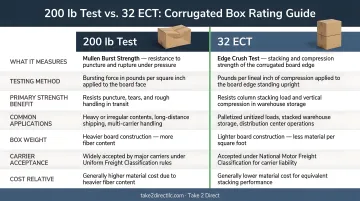
For most standard shipments, UPS packaging guidelines recognize both 200 lb. burst and 32 ECT as acceptable single-wall box options up to 30 lbs. In practice, cost and carrier-specific requirements drive the decision more than any meaningful performance difference between the two.
What Is 200 lb. Test?
The "200 lb. test" designation refers to the Mullen Burst Test, governed by TAPPI/ANSI T 810. A corrugated board specimen is clamped between two platens and pressurized until it ruptures. That peak pressure — measured in psi — is the bursting strength.
A rating of 200 means the board withstands 200 psi before rupturing.
This standard has been in use since the 1940s. It was the primary box strength specification for decades before the Edge Crush Test entered the picture.
Construction and Material
200 lb. test boxes use heavier-weight linerboard and medium. That heavier construction delivers roughly 60% greater bursting strength than 32 ECT equivalents. The added material means:
- Higher resistance to punctures and side-wall impact
- More consistent performance when contents shift or press against box walls
- Slightly heavier box weight per unit
- Higher cost per box than comparable 32 ECT options
What the Certification Stamp Looks Like
Boxes certified to this standard display a circular Mullen Burst Test stamp on one of the bottom flaps. Per Rule 41 (the Uniform Freight Classification governing corrugated packaging standards), the stamp is typically 3 inches in diameter (±¼ inch) and includes:
- Manufacturer name, city, and state
- Bursting test value
- Maximum size limit
- Gross weight limit
Use Cases for 200 lb. Test
This rating is the better choice when:
- Contents approach or exceed 35 lbs
- Products are fragile, high-value, or expensive to replace if damaged
- Shipments travel long-haul freight or multi-stop LTL routes with rough handling exposure
- Contents could press against or puncture box walls (sharp edges, irregular shapes)
- Carriers or shippers specifically require Mullen Test certification
- Common applications include industrial parts, auto components, heavy consumer goods, and manufacturing equipment
Understanding when 200 lb. test earns its cost premium sets up the key question: when does 32 ECT perform just as well for less?
What Is 32 ECT?
32 ECT stands for Edge Crush Test with a rating of 32. Governed by TAPPI/ANSI T 811, this test measures how much force — in pounds per linear inch — a short section of corrugated board can withstand when compressed on its edge before buckling. A 32 ECT board withstands 32 lbs. of force per linear inch of stacking pressure.
The ECT became an accepted alternative under Rule 41 after a 15-year standardization effort. The reasoning was practical: boxes in warehouses, trucks, and distribution centers fail primarily from compression on top, not from something bursting through the wall. Stacking strength turned out to be the more predictive measure of real-world box performance.
Why It's Lighter and Cheaper
32 ECT boxes use lighter-weight paper to achieve equivalent stacking performance. Industry data puts 32 ECT boxes up to 19% lighter than 200 lb. test boxes — a gap that creates real savings at volume:
- Less raw material per unit means a lower cost per box
- Reduced outbound freight weight cuts parcel-rate costs for shippers billing by dimensional or actual weight
What the ECT Certification Stamp Looks Like
The ECT stamp follows the same Rule 41 requirements as the Mullen stamp — circular, approximately 3 inches in diameter — but displays the edge-crush value instead of the bursting test value. You'll see "ECT-32" or "32 ECT" printed on the stamp alongside the manufacturer identity, size limit, and gross weight limit.
Use Cases for 32 ECT
This rating is the better choice when:
- Contents are under 30 lbs
- You're running e-commerce fulfillment or direct-to-consumer shipping
- Cost per box matters at scale — even small per-unit savings multiply across thousands of daily shipments
- Freight weight reduction is a priority
- Products are non-fragile and packaged securely within the box
Common industries include e-commerce brands, consumer goods distribution, 3PL warehouses with mixed SKU profiles, apparel, and electronics accessories. If your operation prioritizes throughput and cost efficiency over heavy-load protection, 32 ECT is typically the right starting point.
Which Box Is Right for Your Shipping Operation?
The Interchangeability Rule
Under Rule 41, single-wall 200 lb. burst and 32 ECT are classified as equivalent for boxes with a maximum gross weight of 65 lbs and outside dimensions up to 75 inches. In practical terms: a box that meets the 200 lb. test standard will also meet the 32 ECT stacking strength requirement. Either is acceptable for the same shipment in most standard applications.
The distinction matters when you push against the edges of that equivalence — heavier contents, tougher handling conditions, or specific carrier mandates.
Choose Your Box Based on These Factors
Choose 200 lb. test if:
- Contents weigh 35–40 lbs
- Your carrier requires Mullen Test certification specifically
- Products will face rough handling (LTL freight, multi-stop routes, international shipping)
- Contents could puncture or press against box walls
- Damage replacement costs are high relative to packaging cost
Choose 32 ECT if:
- Contents weigh under 30 lbs
- You're running high-volume parcel fulfillment where per-box cost compounds daily
- Freight weight reduction matters for your outbound shipping costs
- Contents are well-cushioned and non-fragile
- You're handling e-commerce, consumer goods, or apparel
UPS Carrier Requirements
UPS publishes specific corrugated strength minimums by package weight. Cross-reference your typical package weight against these thresholds before finalizing your box spec:
| UPS Package Weight | Size Limit | Min. Burst | Min. ECT |
|---|---|---|---|
| 0–30 lbs | Under 75 in. | 200 psi | 32 ECT |
| 31–50 lbs | 75–85 in. | 250 psi | 44 ECT |
| 51–65 lbs | 85–96 in. | 275 psi | 55 ECT |
| 66–80 lbs | 95–105 in. | 350 psi | — |
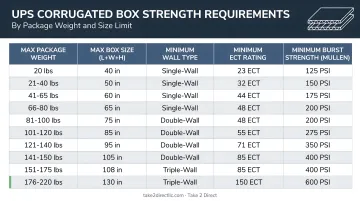
Note that UPS also requires you not to exceed the maximum gross weight printed on the box's manufacturer certification stamp — that limit is specific to each individual box, not just the rating tier.
Getting the Spec Right at Volume
Once you've confirmed your carrier requirements, the next decision is cost efficiency at volume. For distribution facilities and 3PLs, spec errors compound quickly — either through product damage claims or money spent on heavier board than the application needs.
Take 2 Direct carries corrugated boxes with same-day shipping across major U.S. markets including Chicago, Dallas, Los Angeles, and Atlanta, at savings of up to 30% compared to national catalog suppliers. The team brings over 100 years of combined supply chain experience and can help match box specs to your shipment profile before you commit to volume.
Conclusion
Neither 200 lb. test nor 32 ECT is universally better. They measure different things, and both serve legitimate purposes across overlapping applications.
For most shipments under 30 lbs handled in standard conditions, 32 ECT delivers sufficient performance at lower cost. For heavier contents, rough handling environments, or carrier-mandated Mullen compliance, 200 lb. test is the more reliable choice.
If you're unsure which applies, check UPS's published strength table against your typical package weight — then look at the certification stamp on your current boxes to confirm what you're already using.
Getting this right reduces damage claims, keeps you compliant with carrier requirements, and lowers your per-shipment packaging cost — especially across high-volume operations where small per-box decisions add up fast.
Frequently Asked Questions
What does ECT 32 mean?
ECT stands for Edge Crush Test. A rating of 32 means the corrugated board can withstand 32 pounds of force per linear inch when compressed on its edge — this measures resistance to stacking pressure, not bursting from within. It's the most common single-wall corrugated standard for general shipping applications.
What is the difference between 32 ECT lightweight and 200 lb. test?
32 ECT lightweight boxes use less paper material to achieve stacking strength, making them lighter and more economical per unit. 200 lb. test boxes use heavier linerboard for superior bursting resistance. The core difference is what's being measured: compression strength versus wall rupture resistance.
What is the difference between 26 ECT and 32 ECT?
26 ECT (paired with 150 lb. burst) is suited for lighter-duty applications with a Rule 41 gross weight limit of 35 lbs and a 50-inch size limit. 32 ECT handles a broader range with a 65 lb. gross weight limit and 75-inch size limit, making it the more widely accepted choice for standard shipping.
Can I substitute a 32 ECT box for a 200 lb. test box?
Yes for most general shipments — Rule 41 treats them as equivalent alternatives for single-wall boxes. However, if a carrier specifically requires Mullen Test certification, a 32 ECT stamp alone may not satisfy that requirement. Always check your carrier's packaging guidelines.
How do I know which standard my current boxes conform to?
Check the manufacturer's certification stamp on one of the bottom flaps. A circular stamp showing a burst test value (such as 200) indicates Mullen Test compliance; a stamp showing "ECT-32" indicates ECT compliance. Both stamps include the manufacturer name, size limit, and gross weight limit.
What is the maximum weight a 32 ECT box can safely hold?
The general industry guideline for 32 ECT single-wall boxes is approximately 30 lbs of contents (per Uline's buyer guidance). Beyond that threshold, box failure risk increases. For contents in the 30–40 lb. range, 200 lb. test single-wall or a higher ECT rating is the safer choice.