Introduction
Most distribution operations default to the standard 48"×40" GMA pallet without much deliberation. It's familiar, widely available, and works well enough — until it doesn't.
The problem is that "well enough" has a price. When a pallet doesn't match your product footprint, load weight, or handling equipment, the costs accumulate quietly: damaged shipments, wasted trailer cube, rejected pallets at automated induction points, and expedited replacements.
None of these show up as a line item labeled "wrong pallet." But they're there.
According to NWPCA/PalletCentral, the 48"×40" pallet accounts for 35% of U.S. pallet usage, while custom and non-standard sizes represent 39%. That means more operations than most people realize have already moved beyond the default.
Custom pallet design addresses this: pallets engineered around your specific products, loads, handling systems, and shipping environment rather than forcing your operation to adapt to a generic platform.
This guide covers what custom pallet design actually involves, when it makes sense, the key design variables to specify, and how to get one built.
Key Takeaways
- Custom pallets are engineered to match your product dimensions, load requirements, and handling systems — not the other way around.
- Common triggers include irregular product sizes, ASRS/conveyor compatibility gaps, recurring damage claims, poor trailer utilization, and export compliance requirements.
- Key design variables: pallet dimensions, material type, static vs. dynamic load capacity, entry type (2-way vs. 4-way), and compliance requirements like ISPM-15.
- Working with a supply chain partner rather than a catalog vendor produces better outcomes and can cut costs by up to 30%.
What Is Custom Pallet Design?
Custom pallet design is the process of engineering a pallet from the ground up based on specific product, load, handling, and shipping requirements — rather than selecting from a catalog of standard sizes.
The GMA 48"×40" pallet has earned its place: it handles a broad range of general freight, fits most trailers efficiently, and is compatible with common forklift configurations. But "general-purpose" means it was designed for no one in particular.
When applied to products it wasn't built for — oversized goods, heavy concentrated loads, automated induction systems — it creates inefficiencies that add up fast.
What Goes Into a Custom Pallet Specification
A proper custom pallet specification accounts for:
- Product dimensions and total weight, including how mass is distributed across the deck
- Load profile — uniform spread versus concentrated points that stress specific boards
- Handling equipment — forklift type, conveyor specs, and ASRS induction clearances
- Storage environment — rack type, stacking height, cold storage, or humidity-controlled spaces
- Transport mode — LTL, truckload, intermodal, or air freight each impose different stress profiles
Types of Custom Pallets
| Type | Best For |
|---|---|
| Custom-dimension wood stringer | General freight, cost-sensitive applications, single-use |
| Block pallet (4-way entry) | High-density warehousing, high-throughput facilities |
| Plastic | Food, pharmaceutical, hygiene-sensitive environments |
| Metal | Extreme loads, harsh environments, long-cycle reuse |
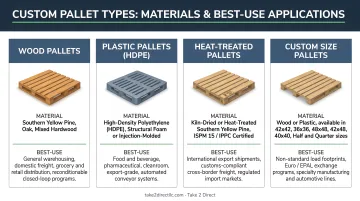
Wood remains by far the most common choice. Modern Materials Handling's 2025 pallet survey found that companies rely on wood pallets for 92% of shipments, with plastic and composite options serving specialized applications.
Choosing the right material is only part of the equation — engineering the structure for your actual load conditions is what separates a functional pallet from one that fails in transit.
The Role of Engineering
Tools like the Pallet Design System (PDS) — developed by WoodPackGlobal/NWPCA — use structural analysis and safe-load modeling to determine deck board placement, nail patterns, and wood species selection based on your actual load conditions. This eliminates the variability that comes from leaving those decisions to the manufacturer's discretion.
When Does Your Operation Need a Custom Pallet?
The short answer: when your standard pallet is creating costs that a better-fitting design would eliminate. Here are the clearest signals.
Irregular or Oversized Products
Products that extend beyond a standard pallet footprint become unstable during transit. Products that don't fill the deck leave unsupported areas that flex under load. Both scenarios increase damage rates and often trigger over-packaging as a workaround — adding cost without fixing the root problem. A custom footprint eliminates the workaround entirely.
Automated and High-Throughput Facilities
Conveyors, robotic arms, and ASRS systems are engineered to precise tolerances. Even minor dimensional variance — a slightly warped board, a protruding nail, an off-spec stringer — can cause failed induction, sensor misreads, or system jams that halt an entire line.
Automated systems inspect pallets at induction for dimensional accuracy, alignment, and weight. Non-compliant pallets don't just get rejected — they can damage the equipment itself. In these environments, a custom pallet with consistent, verified dimensions isn't optional.
Persistent Product Damage
Recurring damage during shipping often gets attributed to packaging, but the real issue is frequently load support. If a pallet deck flexes, the packaging absorbs that stress — and eventually fails. A custom design can redistribute load across the deck, add intermediate supports, or adjust board spacing to better cradle the specific product being shipped.
Poor Trailer or Warehouse Space Utilization
A pallet that doesn't align with your product footprint creates dead space — in trailers, in rack bays, and in storage areas. That dead space has a direct cost per shipment. Custom dimensions that match your product's actual footprint allow configurations that maximize cube utilization and reduce per-unit freight spend.
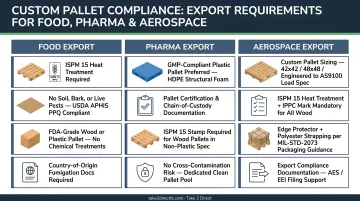
Compliance and Specialized Shipping Requirements
Some applications require compliance from the start, not as a retrofit:
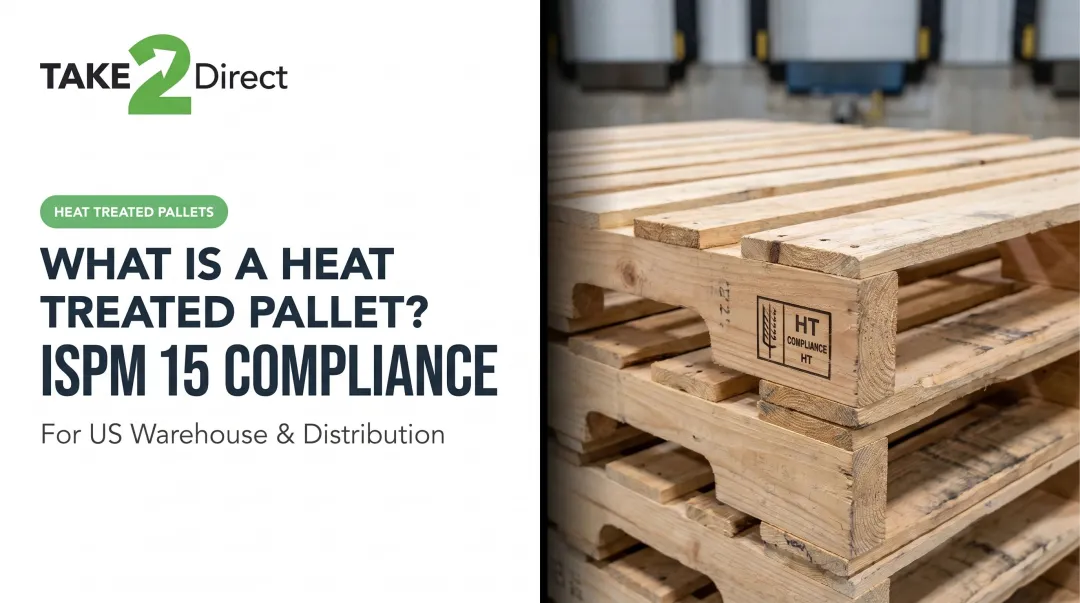
- International export — wood pallets must comply with ISPM-15 regulations, requiring heat treatment to 56°C at the core for at least 30 minutes
- Food and pharmaceutical — FDA sanitary transportation rules require pallets to be maintained in sanitary condition and stored to prevent contamination
- Aerospace and defense — material traceability documentation may be required from the point of manufacture
Building these requirements into the pallet specification from the start is far simpler than retrofitting compliance onto an existing design.
Key Design Factors for Custom Pallets
Dimensions and Load Capacity
Pallet length and width must accommodate your product's footprint without unsafe overhang — product that extends beyond the deck edge becomes a leverage point that can tip or damage loads in transit.
Height matters too, particularly for racking applications where vertical clearance is tight.
Two load capacity values must be specified — not one. Static load capacity is the weight the pallet can support while stationary in racking; dynamic load capacity is the weight it can carry while in motion on a forklift or conveyor. These are different numbers, and both need to match your actual application. ASTM D1185 provides the testing framework for establishing these ratings under specific support and loading conditions.
Material Selection
Once you've locked in dimensions and load requirements, material choice determines how that pallet holds up in your specific environment.
Wood options:
- Hardwood — higher durability and load capacity; preferred for heavy, repeated-use applications
- Softwood (such as Southern Yellow Pine) — cost-effective for lighter loads or single-use scenarios
- Plywood decking — adds dimensional stability for products requiring a flat, gap-free surface
U.S. pallet production used 4.1 billion board feet of hardwood and 5.0 billion board feet of softwood in 2016 — a roughly 45/55 split, with softwood favored for its lower cost in high-volume, lighter-duty applications.
Non-wood alternatives:
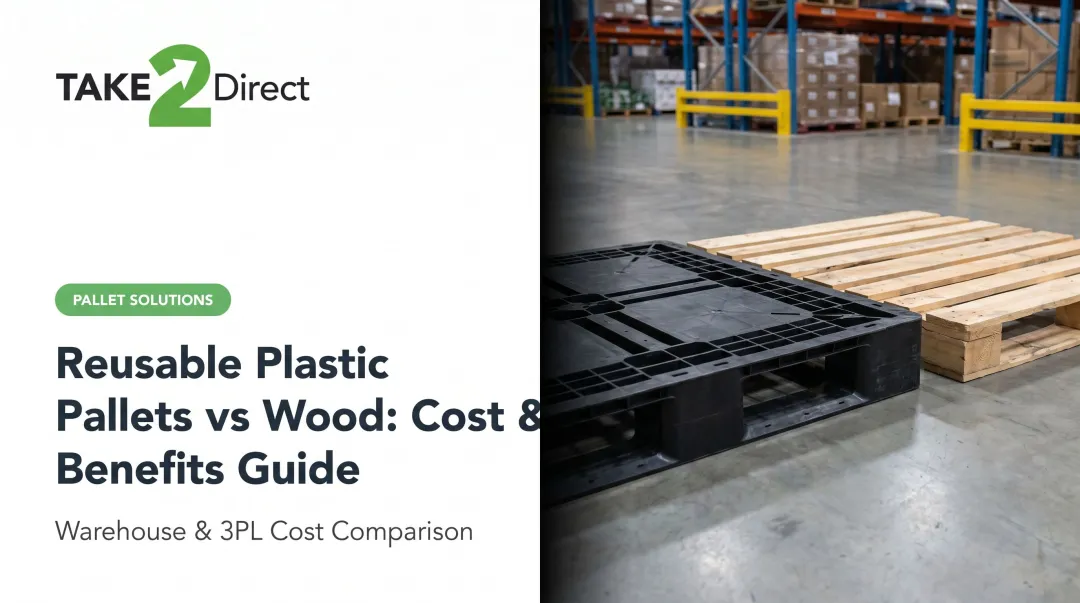
- Plastic — hygienic, dimensionally consistent, higher upfront cost; suited for pharmaceutical and food environments
- Metal — maximum durability for extreme loads or harsh environments; heaviest and most expensive option
Structural Configuration
Entry type:
- Stringer pallets (2-way entry) use parallel boards running lengthwise; standard in North America; notched versions allow partial 4-way entry
- Block pallets (4-way entry) use corner and center blocks between decks; allow full forklift access from all sides; better suited for high-density warehousing
The choice comes down to your handling equipment. If forklifts need to access from multiple directions — common in tight storage configurations — block construction is the right call.
Fastener and deck board specifications:
Nail type, count, and placement, along with deck board thickness and spacing, affect pallet strength and consistency across production runs. These should be specified explicitly rather than left to the manufacturer's judgment. Unspecified fastener details are one of the most common sources of batch-to-batch variation in custom pallet programs.
Benefits of Custom Pallet Design for Your Supply Chain
Reduced Product Damage
A pallet designed to properly support your specific load minimizes stress on packaging during transit. The structural analysis behind a properly engineered pallet targets the actual stress points — deck board gaps, span distances, edge support — rather than relying on generic specifications that may or may not match your load.
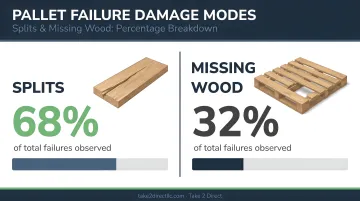
Virginia Tech's Center for Packaging and Unit Load Design identified splits (59.4% of stringer pallet failures) and missing wood (32.4%) as the dominant damage modes in distribution. These aren't random failures — they're predictable outcomes of pallet designs that weren't matched to their loads.
Lower Total Cost of Ownership
The upfront cost of a custom pallet is higher than an off-the-shelf standard. But that comparison doesn't account for:
- Damage claims and returns
- Over-packaging costs used to compensate for poor load support
- Rejected pallets at automated induction points
- Wasted trailer cube across thousands of shipments
- Higher replacement frequency for poorly specified pallets
When these downstream costs are included, custom pallet programs frequently generate net savings. Take 2 Direct's custom pallet programs run up to 30% less than national catalog suppliers — making a well-specified program easier to justify on paper and in practice.
Operational Consistency and Scalability
A standardized custom pallet specification deployed across multiple facilities eliminates the variability that creates friction between production sites, 3PL partners, and end customers. Consistent dimensions produce consistent behavior wherever the pallet goes:
- Automated induction systems accept loads without manual intervention
- Racking configurations stay predictable across facilities
- Delivery destinations receive product in the same condition every time
Take 2 Direct's regional presence across markets including Chicago, Dallas, Los Angeles, and Atlanta makes multi-facility standardization practical — one supply chain partner managing specification consistency across locations.
How to Get Your Custom Pallet Built
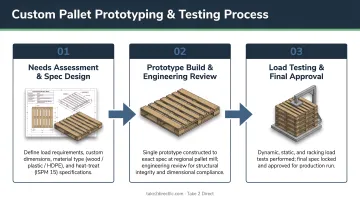
Getting a custom pallet right takes three steps: a clear brief, the right partner, and real-world testing before full production. Here's how each one works.
Step 1: Document Your Requirements
Before any design conversation, gather:
- Product dimensions and weight (including the heaviest SKU on each pallet configuration)
- Current damage data — claim frequency, damage type, where in the supply chain it occurs
- Handling equipment specs — forklift type, conveyor dimensions, ASRS induction tolerances
- Storage environment — rack type, stacking configuration, temperature conditions
- Any compliance requirements — export destinations, food/pharma handling, traceability needs
This information forms the brief. Without it, any supplier is guessing.
Step 2: Work With a Supply Chain Partner, Not Just a Pallet Vendor
A catalog supplier ships what's in stock. A supply chain partner engineers a solution that holds up across your entire unit load system — through your facility, your distribution network, and your compliance requirements.
In complex environments — automated facilities with tight dimensional tolerances, multi-DC operations, or regulated supply chains — that distinction has real cost implications. Take 2 Direct brings over 100 years of combined supply chain experience to custom pallet projects, with sourcing and specification standardization across 10 U.S. market locations to keep your design consistent wherever your operation runs.
Step 3: Prototype, Test, and Refine
Before committing to a full production run, build and test a prototype under real conditions:
- Load it with your actual product at maximum weight
- Run it through your handling equipment — forklifts, conveyors, ASRS induction
- Verify compliance requirements are met (ISPM-15 marking, documentation, etc.)
- Check fit in your actual rack configuration and trailer layout
Adjustments at the prototype stage cost far less than discovering a design issue after 5,000 pallets have been produced.
Frequently Asked Questions
What is a custom pallet?
A custom pallet is engineered to specific product dimensions, load requirements, and handling conditions — as opposed to an off-the-shelf standard size. Custom pallets can be made from wood, plastic, or metal depending on the application, and are built to fit the operation rather than forcing the operation to adapt.
How much does a custom pallet cost?
Pricing varies based on material type, dimensions, load capacity, and order volume. The higher per-unit cost is typically offset by reduced damage rates, better space utilization, and longer pallet life. Take 2 Direct customers often save up to 30% compared to national catalog suppliers.
What materials are custom pallets made from?
The three main categories are wood (hardwood, softwood, or plywood decking), plastic, and metal. Wood is the most common choice for its cost-effectiveness and versatility. Plastic serves food and pharmaceutical environments that require hygienic surfaces, while metal handles extreme loads or harsh conditions where other materials fall short.
What is the difference between a stringer pallet and a block pallet?
Stringer pallets use parallel boards running lengthwise and typically allow 2-way forklift entry (or partial 4-way with notched stringers). Block pallets use corner and center blocks and allow full 4-way entry. The right choice depends on your handling equipment and facility layout.
Do custom pallets need to be heat treated for international shipping?
Yes — wood pallets used in international shipping must comply with ISPM-15 regulations, which require heat treatment to 56°C at the core for at least 30 minutes (or methyl bromide fumigation as an alternative). This can be built into the custom pallet spec from the start; Take 2 Direct offers ISPM-15 compliant heat-treated pallets across all U.S. markets.