The decision between reusable plastic and wood pallets affects more than material preference. It shapes your total cost of ownership, your ability to pass hygiene audits, how well your pallets perform in automated systems, and whether you absorb compliance headaches on international shipments.
This guide breaks down both options — cost, durability, hygiene, sustainability, and fit — so you can make the call based on your actual operation, not industry habit.
Key Takeaways
- Wood pallets cost $10–$25 each; plastic runs $40–$120, though plastic's cost per trip falls sharply over repeated use cycles
- Wood wins for one-way shipping, open-loop networks, and operations where low upfront cost matters most
- Plastic wins in closed-loop systems, food/pharma supply chains, automated warehouses, and international shipping
- Neither material is universally better — the right choice depends on your supply chain model and what you're actually optimizing for
Reusable Plastic Pallets vs. Wood: Quick Comparison
Here's how the two stack up across the factors that matter most in day-to-day operations:
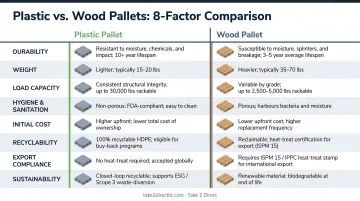
| Factor | Wood Pallets | Reusable Plastic Pallets |
|---|---|---|
| Upfront Cost | $10–$25 per unit | $40–$120 per unit |
| Lifespan | A few years with repairs | 8–15 years under normal use |
| Trip Capacity | ~25 trips (wood block) | 100–200+ trips |
| Hygiene | Porous; absorbs moisture and bacteria | Non-porous; pressure-washable |
| Automation Fit | Variable dimensions; debris risk | Consistent dimensions; conveyor-safe |
| ISPM-15 Compliance | Heat treatment required for export | Exempt from ISPM-15 requirements |
| Repairability | Yes — boards can be replaced | No field repair; replaced at end of life |
| Sustainability | 95% recovery rate; lower production carbon | 100% recyclable HDPE; higher production footprint |
A Note on Sustainability
On a single-trip basis, wood holds a clear carbon advantage. A peer-reviewed Penn State life cycle assessment (2020) found that wood pallets using conventional heat treatment had a carbon footprint 71.8% lower than plastic. Plastic's advantage only emerges over many reuse cycles — the study notes plastic pallets can last over 200 round trips, which eventually offsets their petroleum-based production footprint.
That long-term calculus also depends on how well each material is recovered at end of life. Wood's record here is stronger than many assume: 95% of wooden pallets are recovered into usable materials, with landfill volumes dropping from 178.5 million units in 1998 to 25.4 million in 2016.
What Are Reusable Plastic Pallets?
Reusable plastic pallets are injection-molded from high-density polyethylene (HDPE), polypropylene (PP), or copolymer blends. Unlike corrugated or single-use wood alternatives, they're engineered for repeated cycling — dozens to hundreds of trips — in a managed supply chain.
The "reusable" distinction matters operationally. These aren't pallets you use twice. They're assets designed to stay in rotation for years.
Durability and Lifespan
Plastic pallets don't splinter, warp, or attract pests. They handle temperature extremes well — a real advantage in cold chain and freezer applications where wood can warp and create misalignment in deep-lane storage systems.
On trip capacity, manufacturer data gives a useful range:
- iGPS reports its HDPE pallets average 100 trips vs. 25 for wood block pallets
- ORBIS claims its Odyssey pallet achieves 400 trips vs. 11 for wood
- Penn State's LCA estimates 200+ round trips for well-maintained plastic pallets
These figures vary by manufacturer and use conditions, but the pattern is consistent: plastic pallets outlast wood in closed-loop use.
Hygiene and Compliance
The non-porous surface is the defining hygiene advantage. Spills, bacteria, and mold cannot penetrate the material — the pallet can be fully sanitized with high-temperature water or pressure washing.
Under the FDA FSMA Sanitary Transportation rule (21 CFR Part 1), pallets are classified as transportation equipment. FDA guidance specifically identifies poor pallet quality as a risk factor for physical, chemical, and biological contamination.
The USDA Forest Service has documented that mold on wood pallets has caused product rejection in actual operations. That said, peer-reviewed evidence on the microbial question is more nuanced than most marketing suggests. Plastic's real advantage is ease of cleaning and inspection, not a guaranteed reduction in microbial transfer.
Automation Compatibility
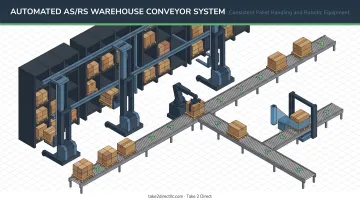
Consistent molded dimensions give plastic pallets a meaningful edge in automated environments. In AS/RS and robotic handling systems, that consistency reduces jams, conveyor errors, and vision-system failures. According to Swisslog, wood pallet dimensional variation causes misalignment in automated deep-lane systems — a problem plastic pallets eliminate by design.
What Are Wood Pallets?
Wood pallets — primarily oak and pine in stringer or block construction — have been the U.S. logistics standard for decades. That 93% market share reflects real advantages, not just inertia.
The 48x40 GMA pallet is the most common single footprint in U.S. commerce, used across grocery, retail, and general freight. It's not universal (the 48x40 represents roughly a third of all pallets produced), but it's the baseline most operations reference.
Core Strengths
- Affordable upfront cost with widespread local availability
- Repairable on-site — broken boards swap out without replacing the whole unit
- Biodegradable at end-of-life with a 95% recovery rate
- Easy to source, price-compare, and procure in volume
Wood pallet pricing does fluctuate with lumber markets. The Producer Price Index for wood container and pallet manufacturing climbed 51.7% from January 2021 to its April 2022 peak before pulling back — a procurement risk that plastic pallet costs don't carry in the same way.
Key Limitations
- Porous material absorbs moisture, bacteria, and spills
- Prone to splintering (worker safety concern) and warping
- Dimensional inconsistency across batches affects automation compatibility
- Restricted or scrutinized in FDA-regulated and pharmaceutical environments
- Requires ISPM-15 heat treatment certification for international shipments, adding cost and lead time
For open-loop, single-trip domestic freight, wood usually wins on cost. The calculus shifts once you factor in closed-loop returns, sanitation requirements, or tight automation tolerances — which is where plastic pallets enter the conversation.
Which Is Right for Your Operation?
Start With Your Supply Chain Model
The single most important variable is whether you run a closed-loop or open-loop system.
- Closed-loop: Pallets return to origin after each delivery (manufacturer → retailer → back). Plastic's higher upfront cost is spread across dozens of reuse cycles, dropping the cost per trip well below wood.
- Open-loop: Pallets travel one-way and are left, exchanged, or abandoned. Wood's low per-unit cost wins here — you're not recovering the asset anyway.
Total Cost of Ownership: A Realistic Look
ORBIS estimates plastic pallets cost roughly $6 per year over a decade, compared to $10 per year for wood, when accounting for longer service life, lower repair costs, and reduced disposal fees. That's manufacturer data, so treat it as directional rather than universal — your actual numbers depend on trip volume, damage rates, and how tightly you manage your loop.
A rough illustration using common market benchmarks:
| Scenario | Wood | Plastic |
|---|---|---|
| Unit cost | $15 | $70 |
| Replacements over 10 years | 3–4x | 0–1x |
| Total pallet cost | $45–$60 | $70–$80 |
| Repair/disposal costs | Additional | Minimal |
| Effective 10-year cost | $55–$75+ | ~$70–$80 |
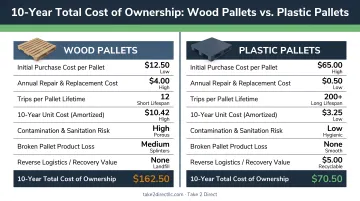
In closed-loop operations with high trip volumes, plastic often closes or reverses that gap. In open-loop operations, wood wins on cost outright.
Those numbers should anchor your decision — but operational fit matters just as much as pure cost.
Situational Recommendations
Choose plastic if:
- Hygiene compliance is required (FDA FSMA, BRC, pharmaceutical GMP)
- Your facility uses automated conveyors, AS/RS, or robotic handling
- You operate a closed-loop or managed pool network
- You ship internationally and want to avoid ISPM-15 heat treatment costs and delays
Choose wood if:
- You ship one-way or in open-loop networks
- Your products are non-perishable general freight
- Upfront budget is the primary constraint
- You prioritize repairability and biodegradable end-of-life
Where to Source Both
If you need both pallet types — or want flexibility to shift between them — Take 2 Direct sources plastic and wood pallets from a single account. Pricing runs up to 30% below national catalog suppliers, with same-day or next-day delivery across 10 U.S. markets including Atlanta, Chicago, Dallas, Los Angeles, and NYC.
Plastic pallets are 100% recyclable and made in the USA. Take 2 Direct also runs post-industrial buy-back programs, so end-of-life pallets don't become a disposal problem.
Conclusion
Reusable plastic pallets make financial and operational sense in closed-loop systems, automated facilities, and hygiene-regulated industries. Wood pallets remain a reliable, cost-efficient choice for one-way shipping, general freight, and operations where low upfront cost matters more than long-term asset management.
The right choice comes down to three things: your shipping model, your industry's compliance requirements, and whether you're optimizing for purchase price or total cost of ownership. Get those three factors clear, and the decision typically makes itself.
If you're still working through that decision, or you're ready to source either type at competitive pricing, Take 2 Direct can help. The team has deep hands-on experience evaluating pallet programs for 3PLs, distribution facilities, and operations of all sizes — and they can get product to you fast. Call 720.230.6926 or contact your regional manager to request a quote.
Frequently Asked Questions
Are plastic pallets cheaper than wood?
Wood pallets have a lower upfront cost ($10–$25 vs. $40–$120 for plastic), but plastic can be more cost-effective over time in closed-loop operations. With a lifespan of 8–15 years and minimal repair costs, the cost per trip often favors plastic when pallets are actively recovered and reused.
How long will plastic pallets last?
Reusable plastic pallets typically last 8–15 years under normal conditions, with manufacturer data suggesting 100–200+ trips depending on grade and use. Wood pallets generally require repair or replacement within a few years, particularly under heavy or outdoor use.
What can I use instead of wooden pallets?
The most common alternatives include:
- Reusable plastic pallets (HDPE or polypropylene)
- Metal or aluminum pallets for heavy or sanitary applications
- Corrugated pallets for lightweight one-way shipments
- Hybrid composite designs
Are plastic pallets better for food and pharmaceutical industries?
Generally, yes. Plastic pallets are non-porous, easy to sanitize, and meet FDA FSMA Sanitary Transportation requirements for contamination control. Wood's porosity makes it harder to fully clean and can harbor mold — a documented cause of product rejection in food supply chains.
Can plastic pallets be used for international shipping?
Plastic pallets are exempt from ISPM-15 phytosanitary regulations, which require heat treatment certification for wood pallets crossing international borders. This makes them faster and simpler to move across borders — no treatment documentation, no risk of delays from non-compliant wood packaging.