Introduction
Every pallet that leaves a warehouse floor represents a calculated risk. If the strapping fails — wrong material, wrong width, wrong tensile strength — the load shifts, product gets damaged, and someone is filing a freight claim instead of processing a delivery confirmation.
The problem is that most procurement teams treat strapping like a commodity. It isn't. With three primary material types (and a growing fourth), dozens of width and thickness combinations, and real differences in how each material behaves under tension, choosing the wrong strap can cost far more than any per-foot savings upfront.
According to Grand View Research, the global packaging strapping materials market is projected to reach $15.7 billion by 2033, growing at a 6.0% CAGR — driven largely by rising e-commerce volumes and increasing demand for secure long-haul freight.
This guide breaks down the four primary strapping band types, how to match each to specific load requirements, and what to look for when sourcing at volume — so your operation stops treating strap selection as an afterthought.
Key Takeaways
- Strapping bands (also called banding) are flat loop materials used to secure, bundle, or palletize loads for shipping and storage
- The four primary types are polypropylene (PP), polyester (PET), steel, and woven/composite — each suited to different load profiles
- PP suits light-to-medium loads; PET covers most industrial applications; steel is required for some railroad transport
- Woven/composite strapping is the go-to choice for fragile or high-value equipment
- Selection hinges on load weight, tensile strength, elongation recovery, and transit distance
- Sourcing from a supplier with broad inventory and same-day fulfillment prevents line stoppages when strapping stock runs low
What Are Strapping Bands and Why Do They Matter?
Strapping bands (also called banding) are flat loop materials made from plastic, composite fiber, or metal. Their job is to bundle products, reinforce cartons, and secure pallet loads during transit and warehousing. The terms "strapping" and "banding" are interchangeable in industrial contexts, though "banding" tends to appear more often in light-duty or product-bundling applications.
Strapping doesn't work in isolation. It complements stretch wrap, edge protectors, and dunnage as part of a complete load-securing system. Within that system, strapping is the component that carries tensile load — the one thing holding a pallet together when a truck brakes hard or a load shifts mid-haul.
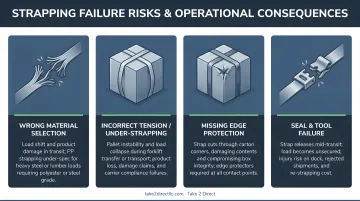
Using the wrong strapping type creates real operational risk:
- Too weak: strap breaks in transit, load collapses, freight claim filed
- Too rigid: strap can't absorb load settlement, tension releases, goods shift
- Wrong width: insufficient contact area drops holding force below safe threshold
- Wrong material: UV exposure, moisture, or temperature degrades strap integrity before delivery
FMCSA cargo securement rules require that the aggregate working load limit of all securement devices be at least one-half the weight of the article being secured. That makes strapping selection a regulatory consideration, not just a packaging one.
Best Strapping Bands for Industrial Packaging and Shipping
The four material types below cover the broadest range of industrial shipping needs, selected based on tensile strength range, application versatility, industry adoption, and total cost of ownership.
Polypropylene (PP) Strapping
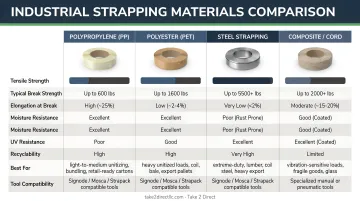
PP strapping is the most widely used and economical option on the market. It's available in widths from 1/4" to 3/4", almost always embossed for added friction, and applies via hand tools or fully automated strapping machines.
Signode's PP Strand lists break strengths from 120 lb to 600 lb across widths of 3/16" to 1/2". Machine-grade versions use virgin resin to ensure consistent camber for automated chute feeding.
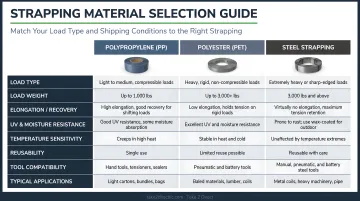
PP's key characteristic is its stretch-and-recovery behavior. It stretches during tensioning and partially recovers after application, making it well-suited to loads that compress or settle after strapping — corrugated cartons, printed materials, and food distribution pallets where the load mass redistributes during transport.
Standard PP has limitations in prolonged UV exposure and extreme temperatures. UV-stabilized formulations address this for outdoor or extended-transit applications.
| Spec | Detail |
|---|---|
| Tensile Strength Range | ~120 lb to 1,000 lb (light to medium duty) |
| Best Applications | Printed materials, food distribution, flooring, millwork, pharmaceutical DC pallets, hay baling |
| Cost Level | Lowest of all primary types |
Polyester (PET) Strapping
For most industrial applications, PET strapping has become the standard alternative to steel. It's available in smooth and embossed finishes and applies via manual buckles or heat/friction weld machines.
Sustainability is a practical advantage here too: FROMM states its PET strapping is made from 96–100% recycled PET, which is why most PET strap is green.
Signode's Tenax PET documentation confirms what operations teams experience in practice: PET yields higher break strengths and maintains a higher level of retained strap tension than polypropylene. That tension retention is the critical differentiator for long-haul and multi-stop freight, where loads experience repeated deceleration and load shifting.
The Greenbridge 2023–2024 catalog lists PET break strengths from 300 lb to 4,000 lb depending on width and thickness — a range that overlaps significantly with steel while offering safer handling (no sharp edges), no rust risk, and easier disposal.
| Spec | Detail |
|---|---|
| Tensile Strength Range | 300 lb to 4,000 lb |
| Best Applications | Metals, lumber, bricks, tiles, palletized bottles and cans, heavy manufacturing loads, cross-country freight |
| Cost Level | Mid-to-high; significantly less expensive than steel with lower total cost of ownership for heavy loads |
Steel Strapping
Steel is the oldest strapping material and retains its position in specific high-duty applications. It's required by the Association of American Railroads (AAR) for open-top railroad transport under AAR Circular 43-I (April 2025), which mandates that straps meet ASTM D3953 and that combined joint strength equals the weight of the freight being secured.
Signode's steel strapping line illustrates the range: standard Apex product runs from 650 lb to 1,990 lb break strength; high-tensile Magnus steel reaches 1,900 lb to 13,200 lb across widths from 5/8" to 2".
Steel's advantages are absolute break strength, zero elongation once applied, and resistance to high temperatures. That said, the operational tradeoffs are significant:
- Sharp edges create handling and injury risk (PPE required for application and removal)
- Susceptible to rust when exposed to moisture
- Requires dedicated tooling — manual tensioners, seals, pliers, or pneumatic tools
- Bending around pallet corners reduces effective holding strength
| Spec | Detail |
|---|---|
| Tensile Strength Range | 650 lb to 13,200 lb (standard to high-tensile) |
| Best Applications | Heavy industrial machinery, steel coils, construction materials, railroad transport, heavy non-compressible loads |
| Cost Level | Highest of all types; labor and tooling costs add to total cost |
Woven / Composite Strapping
Woven (also called composite or cord) strapping is made from interwoven polyester or polypropylene fibers. It applies with a ratcheting tensioner and high-joint-efficiency buckle, which makes it accessible to less experienced handlers without sacrificing holding power.
Greenbridge's woven cord strapping covers 500 lb to 5,400 lb break strength for heavy and extra-heavy-duty applications. Cordstrap's standard composite systems range from 730 lb to 4,680 lb, available in widths from 1/2" to 1-1/4".
The primary use case is loads where steel's sharp edges would cause damage — high-value industrial equipment, fragile machinery, and irregularly shaped freight that doesn't present a clean strapping path. It's also weather-resistant and outperforms standard PP in outdoor or variable-temperature environments.
| Spec | Detail |
|---|---|
| Tensile Strength Range | ~500 lb to 5,400 lb (woven); 660 lb to 3,320 lb (composite) |
| Best Applications | Industrial machinery, fragile or irregular loads, heavy equipment, outdoor freight, applications where handler safety is a priority |
| Cost Level | Comparable to or slightly above PET; cost-justified for specialty or high-value loads |
How to Choose the Right Strapping Band
Load Weight and Tensile Strength
The AAR Circular 43-I requirement for rail transport states that combined joint strength of all straps must equal the weight of the freight being secured. For truck freight, FMCSA sets aggregate working load limit at a minimum of one-half the article weight.
As a practical starting point, consult your strapping supplier with load weight, dimensions, number of straps planned, and shipping method to confirm minimum break strength per strap. Under-specifying creates load failure risk; over-specifying wastes material cost on every pallet.
General width guidance based on manufacturer spec ranges:
- 1/4" machine-grade PP: starting around 200 lb nominal break — light bundles and carton reinforcement
- 1/2" hand-grade PP: up to 750 lb nominal break — medium pallets and consumer goods
- 3/4" PP or PET: 1,000+ lb — standard pallet loads
- 5/8" to 2" steel: 1,900 to 13,200 lb — heavy industrial and rail
Load Characteristics: Rigid vs. Settling
Load behavior after strapping determines material choice more than almost any other factor:
- Settling/compressible loads (corrugated boxes, printed materials, soft goods): PP's stretch-and-recovery behavior maintains strap contact as the load compresses
- Rigid/non-compressible loads (metals, lumber, bricks, tiles): PET or steel, which hold fixed tension without going slack
- Long-haul multi-stop routes: PET's superior tension retention outperforms PP — Signode's own documentation confirms PET maintains higher retained tension over time
Shipping Environment and Distance
Material vulnerabilities vary by environment and route length:
- UV exposure: Standard PP degrades under prolonged sunlight — use PET or woven strapping for outdoor storage or weather-exposed freight
- Moisture: Steel rusts in wet conditions; PET is the better choice for humid environments or open transit
- Long-distance hauls: PET maintains higher initial tension retention over time, making it the right call for heavy loads traveling more than a few hundred miles
Application Method and Volume
EAM-Mosca identifies camber — the curvature of strap as it unwinds from the coil — as a direct cause of machine jams and feed failures. Machine-grade strapping requires virgin resin and tighter process control to minimize it. Recycled strapping works fine for manual application but creates reliability problems in automated systems.
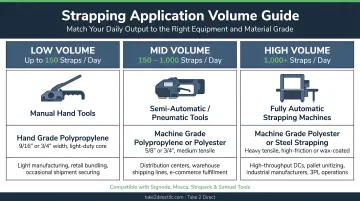
Match your material grade to your equipment and volume:
| Volume | Method | Strapping Grade |
|---|---|---|
| Under ~50 straps/day | Manual hand tools | Hand-grade (PP or PET with buckles) |
| Mid-volume | Semi-automatic machines (~10–15 straps/min per PAC guidance) | Machine-grade virgin PP or PET |
| 500–1,000+ loads/day | Fully automatic systems | Virgin-only machine-grade — critical for camber control |
How We Chose These Strapping Bands — and Why Sourcing Matters
The four types above weren't selected based on price. The evaluation criteria covered:
- Tensile strength range across load types
- Elongation and recovery performance
- Industry certification relevance (steel's AAR compliance, nonmetallic ASTM D3950 standards)
- Breadth of application across distribution, manufacturing, and 3PL environments
- Total cost of ownership
The most common mistake in strapping procurement: choosing on unit price alone. A strap that costs less per foot but fails in transit generates costs that dwarf any purchase savings. The same is true when recycled material with camber issues jams an automated strapping machine mid-shift.
Sourcing logistics matter just as much. A strapping stockout on a high-volume packaging line is an immediate production problem. Operations teams need a supplier that:
- Carries multiple specs across all four material types
- Can confirm machine compatibility before an order ships
- Fulfills quickly enough to prevent line stoppages
Take 2 Direct stocks PP strapping, polyester strapping, steel strapping, and a full range of complementary products (strapping tools, buckles and seals, strap guards, and strapping carts) across its inventory of 20,000+ industrial supply items. With same-day shipping across 10 major U.S. markets (Atlanta, Chicago, Dallas, Los Angeles, Denver, and more) and pricing up to 30% below national catalog suppliers, it's a direct solution for operations teams that need reliable inventory without the wait.
Conclusion
PP, PET, steel, and woven strapping each serve specific load types, shipping conditions, and operational volumes. The right choice comes down to an honest assessment of load weight, rigidity, transit distance, and application equipment.
Evaluate total cost of ownership. Factor in strap failure risk, machine wear from incompatible materials, and the cost of a supply disruption. What looks inexpensive per coil often costs more once downtime, damaged freight, and reapplication labor enter the calculation.
Whether you're stocking a single distribution center or managing packaging supply across multiple fulfillment locations, Take 2 Direct carries a full range of strapping materials with same-day shipping and up to 30% savings versus national catalog suppliers. Reach out to get the right strapping spec matched to your load requirements and equipment setup.
Frequently Asked Questions
What is the difference between banding and strapping?
"Banding" and "strapping" refer to the same category of flat loop material used to secure or bundle loads. The terms are interchangeable in industrial packaging, though "banding" appears more frequently in light-duty or product-bundling contexts and "strapping" in heavier pallet and freight securing applications.
What is the best material for strapping?
It depends on the load. PP is best for light-to-medium settling loads like corrugated cartons. PET is the most versatile option for heavy rigid loads and replaces steel in most industrial applications. Steel is reserved for the heaviest non-compressible loads or where AAR railroad transport regulations apply.
What is the primary use of strapping materials in the packaging process?
Strapping bundles products together, reinforces cartons, and secures pallet loads during transport and storage. It prevents load shifting, product damage, and pallet collapse in transit — and is typically used alongside stretch wrap for maximum load integrity.
Can polyester strapping replace steel strapping?
PET has replaced steel in most industrial applications, offering comparable tensile strength, superior elongation recovery, no rust risk, and safer handling. Steel is still required where PET's break strength ceiling falls short or AAR open-top railroad regulations apply.
What is the difference between virgin and recycled strapping?
Virgin strapping is made from new polymer with consistent camber (minimal coil curve). That consistency is essential for semi-automatic and fully automatic machines — excessive camber causes jams and performance failures. Recycled strapping costs less but has higher camber variability and is appropriate for manual application only.
How do I calculate the right tensile strength for my strapping?
FMCSA requires aggregate working load limit of at least half the article's weight for truck freight; AAR requires combined joint strength equal to freight weight for rail. Consult your strapping supplier with load weight, dimensions, strap count, and shipping method to confirm the right break strength per strap.